
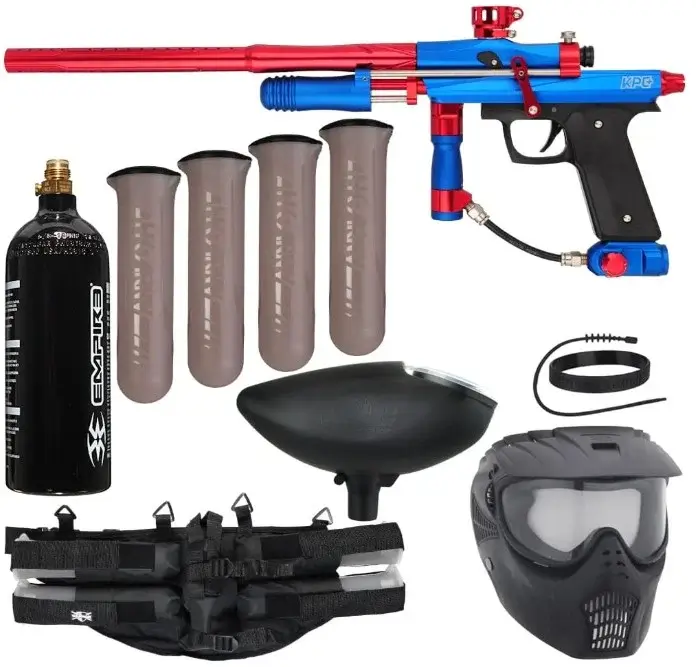
Azodin KPC+
Pump Configuration: Traditional/open-class pump Caliber: .68 Feed: Feedneck/loader Power: CO₂ or HPA Capacity: Feed dependent Best For: Best overall
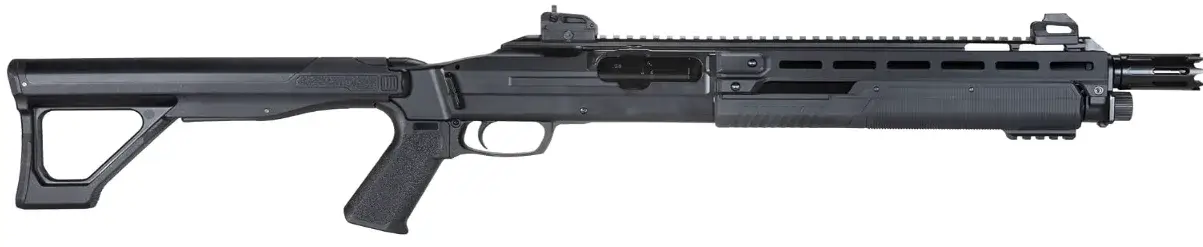
Umarex T4E TX 68
Pump Configuration: Shotgun-style pump Caliber: .68 Feed: Internal magazine Power: Dual 12g CO₂ Capacity: 16 Best For: Best pump shotgun
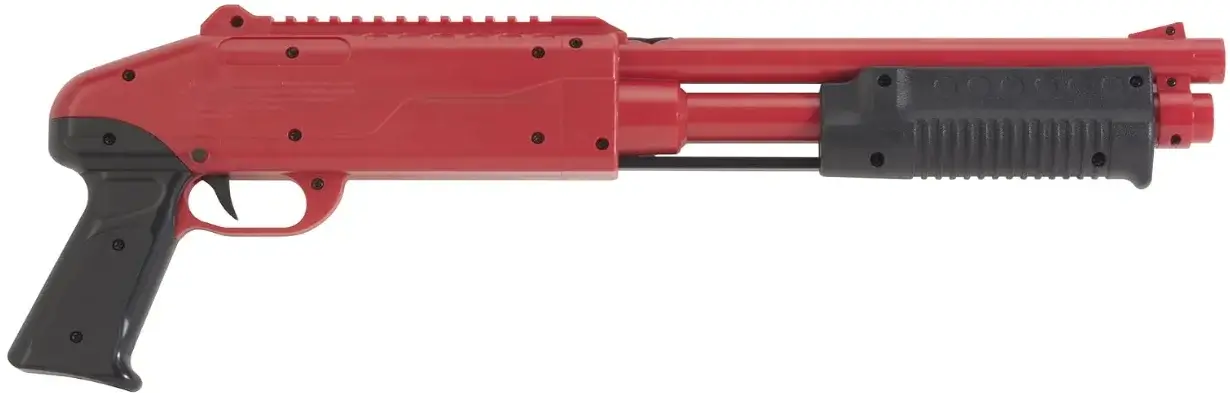
JT SplatMaster Z200
Pump Configuration: Spring pump shotgun Caliber: .50 Feed: Internal feed Power: Spring Capacity: 15 Best For: Best spring-powered pump
Best Pump Paintball Gun Reviews
A good pump marker is defined by more than caliber or FPS. Pump stroke, feed design, ergonomics, and power system shape the experience every time you cycle the action.
Azodin KPC+: Best Pump Paintball Gun Overall
If you want traditional pump play without committing to a strict stock-class setup, the KPC+ makes the most sense.
Azodin built it around a half-block body, stainless-steel pump rod and guide, quick-release bolt, screw-lock feedneck, single-trigger frame, and inline On/Off ASA. It supports both CO₂ and HPA.
Those features matter because the KPC+ is designed around manual cycling rather than adapting another marker format.
The stainless pump rod and guide help keep the stroke controlled, while the reversible Hitman plate gives your support hand another way to work the pump.
The KPC+ also includes an auto-trigger. Hold the trigger and complete successive pump cycles, and the marker can fire as each full cycle finishes.
That does not remove the manual action. It simply allows faster pump cycling when needed.
Azodin also fits a 14-inch .685 barrel and a preset Feather Regulator. Its screw-lock feedneck makes it naturally suited to an open-class setup with a loader.
What you notice in use
The KPC+ feels closest to what most players picture when they hear pump paintball gun.
You cycle a compact pump assembly rather than reaching forward to operate a shotgun fore-end. The feed sits above the marker, while the air source attaches through the bottom ASA.
Its dedicated pump hardware includes a pump handle, guide rod, return spring, pump slide, pump bolt, and pump striker.
Who it is best for
Choose the KPC+ if you want:
- A true .68-caliber pump marker
- Open-class flexibility
- CO₂ or HPA compatibility
- A dedicated pump rod and guide
- Auto-trigger capability
- A Hitman plate
What could be better
The KPC+ needs an external feed setup, so it is less self-contained than the two shotgun-style options.
Its compact pump ergonomics may also feel less natural if you specifically want a long fore-end.
Verdict
The Azodin KPC+ is our best pump paintball gun overall.
It offers the strongest combination of traditional pump architecture, flexible air compatibility, and pump-specific hardware.
Umarex T4E TX 68 Paintball Shotgun
If the appeal is a long receiver, shoulder stock, large fore-end, and deliberate shotgun-style cycling motion, the TX 68 is the better fit.
Umarex describes the T4E TX 68 as a pump-action .68-caliber marker. It uses two 12-gram CO₂ cartridges beneath the buttstock and feeds from a 16-round internal magazine.
The manufacturer also lists a pressure indicator, loading assist, and a maximum velocity of 250 FPS.
Its 6.5-pound listed weight is just as important.
The TX 68 feels far more substantial than the KPC+. Its longer body changes how you shoulder, carry, and cycle it.
Why the shotgun format matters
Instead of a compact pump handle, the TX 68 gives you a broad pump fore-end farther forward.
The internal 16-round magazine also eliminates the external loader used on a typical open-class pump.
Customer feedback often praises the construction and pump-action feel. Weight is more divisive, with some users liking the solid feel and others finding it heavy.
That is believable at 6.5 pounds. Your support arm will notice it.
Who it is best for
Choose the TX 68 if you want:
- A .68-caliber paintball shotgun
- Full pump-action fore-end
- Internal 16-round magazine
- Dual 12g CO₂ operation
- Buttstock
- Full-size shotgun-style handling
What could be better
Its weight is the biggest trade-off.
Loading also differs from a feedneck-based pump, and the dual 12g CO₂ system gives you less air-source flexibility than the KPC+.
Check your venue’s equipment rules before using any unusual shotgun-style platform.
Verdict
The T4E TX 68 is the best pump paintball shotgun in this comparison.
Choose it for the shotgun form factor, not simply because it is another pump marker.
JT SplatMaster Z200 Spring-Powered Paintball Pump
The Z200 takes the simplest approach of the three.
It uses a spring-powered firing system instead of CO₂ or HPA. Each shot requires you to cycle the pump manually.
Its internal feed holds 15 .50-caliber rounds, and the design weighs around one pound.
That gives you a very different experience from the much heavier TX 68.
What makes it different
There is no external air tank or CO₂ cartridge to manage.
Load the feed, cycle the pump, fire, and repeat.
The lightweight plastic and nylon construction makes the Z200 easy to carry, but it does not have the substantial feel of the TX 68 or the conventional open-class architecture of the KPC+.
Its .50-caliber format also puts it in a separate category from the two .68-caliber options.
Customer feedback commonly praises its simple loading and operation. Opinions about range and durability are more mixed.
Who it is best for
Choose the Z200 if you want:
- Manual pump action
- Spring power
- No CO₂ or HPA
- .50-caliber compatibility
- 15-round internal feeding
- Very low overall weight
What could be better
Its lightweight construction is less substantial than the TX 68.
It also delivers a different performance experience from a conventional .68 pump marker.
Verdict
The JT SplatMaster Z200 is the best spring-powered pump shotgun here.
Its main advantage is mechanical simplicity.
Traditional Pump Gun vs Pump Paintball Shotgun: What Is the Difference?
The terminology can be confusing because “pump gun” and “shotgun” are sometimes treated as separate categories.
They are not.
Pump describes the action. Shotgun-style describes the physical design.
A shotgun-style marker can still use manual pump action.
Feature | Traditional Pump Marker | Shotgun-Style Pump |
Pump control | Compact pump assembly | Long fore-end pump |
Feed | Feedneck or tube | Internal feed or magazine |
Power | CO₂/HPA depending on setup | CO₂ or spring |
Shape | Conventional marker profile | Long shotgun-style receiver |
Reloading | Depends on external feed | Internal loading system |
Handling | Usually more compact | Usually longer |
Example | Azodin KPC+ | TX 68 / Z200 |
Choose a traditional pump if you want configuration flexibility and compact handling.
Choose a shotgun-style pump if the fore-end cycling motion and self-contained feed are part of the appeal.
How a Pump Paintball Gun Actually Works
A pump paintball gun requires a complete manual cycle between shots.
The basic sequence is:
Pump stroke → cocking → chambering → trigger pull → next pump cycle
The exact internals vary by platform, but the pump movement prepares the marker for the next shot.
On the KPC+, dedicated components include the pump handle, guiding rod, return spring, pump slide, pump bolt, and pump striker.
Pump-specific components that affect the feel
Several parts directly influence pump smoothness.
- Pump handle or grip: Where your support hand applies force.
- Pump rod or arm: Transfers the pump movement into the action.
- Pump guide: Keeps that movement aligned.
- Return spring: Helps control pump return on designs that use one.
- Pump plate: Can change support-hand placement.
- Bolt and breech: Handle chambering and positioning the paintball.
Excess friction or side movement can make repeated strokes tiring.
That is why pump buyers should care about stroke quality, not just velocity.
What is short-stroking?
Short-stroking happens when you fail to complete the full pump cycle. Depending on the marker, that can interfere with cocking or chambering.
The solution is a clean, complete stroke. Pump paintball has little sympathy for rushed technique.
Does pump automatically mean closed-bolt?
No.
Some famous pump platforms, especially Autococker and Sniper-derived designs, use closed-bolt operation.
But pump action itself does not determine bolt architecture.
That distinction matters when comparing dedicated pumps with older Autococker-derived systems.
Stock Class vs Open Class Pump Paintball
A marker can be pump-action without being stock class. Stock class describes a much more specific setup.
What is stock class paintball?
Under current Stock-Class HQ rules, a qualifying setup must use:
- Manual operation
- An unassisted horizontal feed parallel to the barrel
- A single 12-gram CO₂ cartridge
That usually means limited paint capacity, a horizontal feed tube, and a much more deliberate loading routine.
Some setups also require the player to tilt the marker so the next paintball drops into position.
The key point is simple: Not every pump paintball gun is stock class.
Are any of our three picks true stock-class guns?
Not in their listed factory configurations.
The KPC+ uses a screw-lock feedneck and supports CO₂ or HPA, making it better suited to open-class pump use.
The TX 68 uses a 16-round internal magazine and two 12g CO₂ cartridges.
The Z200 is spring-powered.
The CCI Phantom remains a well-known example of a platform that can be configured for true stock-class play.
What is open-class pump paintball?
Open class keeps manual pump operation but allows more flexible feeding and air systems.
Typical setups may use:
- Vertical feed
- Loader or hopper
- Larger CO₂ system
- HPA
- Greater paint capacity
The KPC+ fits naturally into this category with a suitable feed and air source.
You still pump every shot. You simply gain more flexibility around feeding and air.
What to Look for in a Pump Paintball Gun
Pump buying is different because your support hand operates the action every shot.
That makes ergonomics and cycling quality especially important.
Pump stroke and cocking effort
Pay attention to:
- Pump stroke smoothness
- Stroke length
- Resistance
- Cocking effort
- Handle reach
- Grip comfort
- Side-to-side movement
- Return feel
- Short-stroke tendency
A slightly heavier marker with a cleaner stroke may feel better than a lighter one with a rough pump guide.
Feed configuration
The feed system changes how a pump marker behaves.
- A stock-class feed tube prioritizes limited capacity.
- A vertical feedneck allows an open-class pump to use a loader.
- A shotgun-style internal magazine keeps the system self-contained.
Choose the configuration that matches how you want to load and carry paint.
Power system and compatibility
These three markers use very different systems.
Azodin KPC+
- CO₂ compatible
- HPA compatible
T4E TX 68
- Dual 12g CO₂
JT SplatMaster Z200
- Spring powered
The KPC+ gives you the most air-source flexibility.
The TX 68 hides its CO₂ cartridges inside the shotgun-style body.
The Z200 avoids compressed gas entirely.
Pump ergonomics and construction
Look at:
- Pump handle shape
- Fore-end reach
- Overall length
- Weight
- Pump rod and guide construction
- Buttstock position
- Repeated cycling comfort
The KPC+ keeps the pump movement compact. The TX 68 places your support hand farther forward.
Neither is inherently better. They simply suit different preferences.
Auto-trigger and Hitman plate
The KPC+ includes both an auto-trigger and a Hitman plate.
An auto-trigger allows successive shots while the trigger remains held and you complete full pump cycles.
A Hitman plate changes where your support hand can engage the pump.
Both can make rapid cycling easier, but neither replaces the need for a complete pump stroke.
Buying a Pump Paintball Gun in 2026
Finding pump paintball guns for sale can take more checking than shopping larger marker categories.
Several respected pump models have limited or inconsistent availability.
Before ordering, verify:
- The marker is genuinely pump-action
- The listing is currently in stock
- Whether you are buying a marker or package
- Caliber
- Feed configuration
- Required power source
- Availability of pump rods, guides, seals, and other replacement parts
Also compare marketplace specifications with manufacturer documentation.
For example, Amazon lists a six-round figure for the KPC+ package, but the marker itself uses a screw-lock feedneck. Actual paint capacity depends on the attached feed system.
When marketplace data looks odd, trust the manufacturer’s technical documentation first.
Pump Paintball Gun Maintenance
Paint and dirt around the pump assembly can quickly make a smooth stroke feel rough.
Basic pump-specific maintenance includes:
- Wipe paint from the pump handle and guide
- Check pump rod movement for binding
- Clean the breech and bolt path after breaks
- Inspect relevant seals and O-rings
- Keep internal feed paths clean
- Follow manufacturer-approved lubrication points
- Never force a pump that suddenly becomes difficult to cycle
- Unload and degas the marker before internal service
The exact routine differs by platform.
The KPC+ has a traditional pump assembly, the TX 68 adds an internal magazine and CO₂ system, and the Z200 uses spring power.
Always follow the manual for the specific marker.
Common Pump Paintball Gun Buying Mistakes
A few mistakes cause most pump-buying frustration.
1. Buying something that is not actually a pump marker
A true pump requires manual cycling between shots. Do not rely only on a marketplace title or roundup list.
2. Assuming every pump is stock class
Stock class has specific feed and CO₂ requirements. A conventional pump marker does not automatically qualify.
3. Choosing by FPS alone
Velocity tells you little about pump-stroke quality. Smooth cycling and comfortable ergonomics matter every shot.
4. Ignoring caliber and power-system differences
The Z200 uses .50 caliber and spring power. The KPC+ and TX 68 use .68 caliber but very different air systems. Check compatibility before ordering paint or air equipment.
5. Ignoring pump ergonomics
Reach, grip shape, resistance, and marker length become more noticeable after repeated cycling.
6. Trusting every marketplace specification
Cross-check unusual data with the manufacturer. Pump listings are niche enough that incorrect specifications sometimes get copied across retailer pages.
Frequently Asked Questions
A few pump questions still deserve a direct answer.
Are pump paintball guns more accurate?
Not automatically.
Pump action does not make a paintball mechanically fly straighter.
What often changes is the player’s shooting style. Limited follow-up speed encourages more deliberate shots.
Accuracy still depends on paint quality, velocity consistency, barrel condition, and the individual marker.
Can an Autococker be converted into a pump marker?
Compatible Autococker and Sniper-style platforms can use dedicated pump conversion components.
These may include a pump kit, guide, arm, mounting hardware, and Hitman plate.
A full conversion is a separate Autococker topic, so it is better covered in a dedicated guide.
Final Verdict: What Is the Best Pump Paintball Gun?
The Azodin KPC+ is the best pump paintball gun overall in this comparison.
It gives traditional pump buyers the most relevant mix of manual cycling, open-class flexibility, dedicated pump hardware, and CO₂/HPA compatibility.
Choose the Umarex T4E TX 68 if you specifically want a full-size .68 pump shotgun.
Choose the JT SplatMaster Z200 if you prefer a lighter .50-caliber pump shotgun with a simple spring-powered system.
The deciding question is not which marker has the longest specification sheet.
It is which pump experience you actually want: traditional open-class pump, shotgun-style CO₂ pump, or spring-powered shotgun-style pump.