
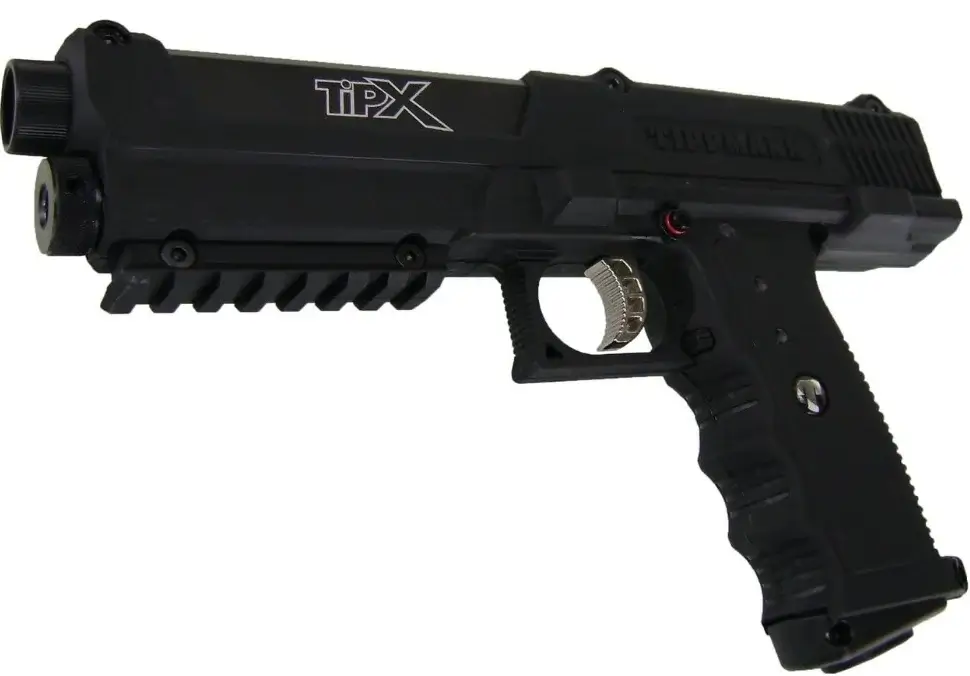
Tippmann TiPX
Caliber: .68 Action: Semi automatic CO₂: 12g CO₂ Capacity: 7 Key Characteristic: Compact .68 platform Best For: Best overall
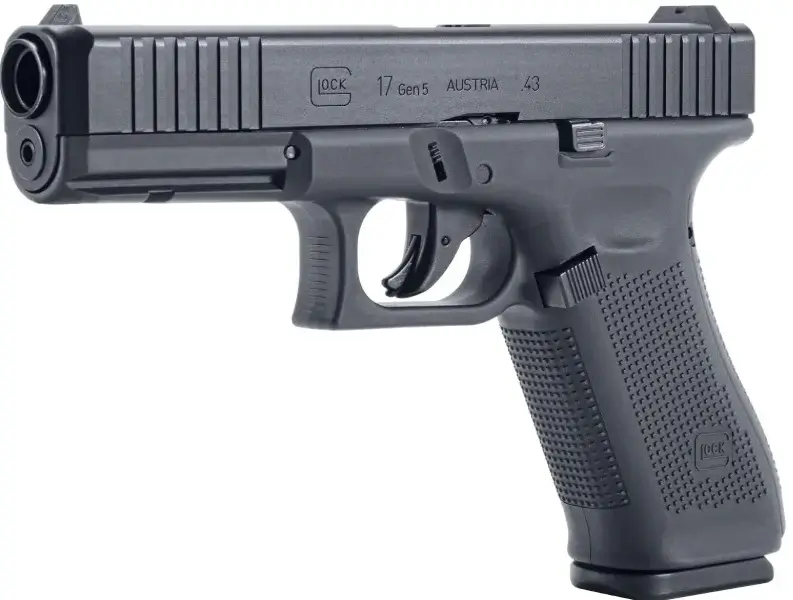
T4E GLOCK 17 Gen5
Caliber: .43 Action: Semi automatic CO₂: 12g CO₂ Capacity: 8 Key Characteristic: Licensed GLOCK replica Best For: Best GLOCK-style pistol
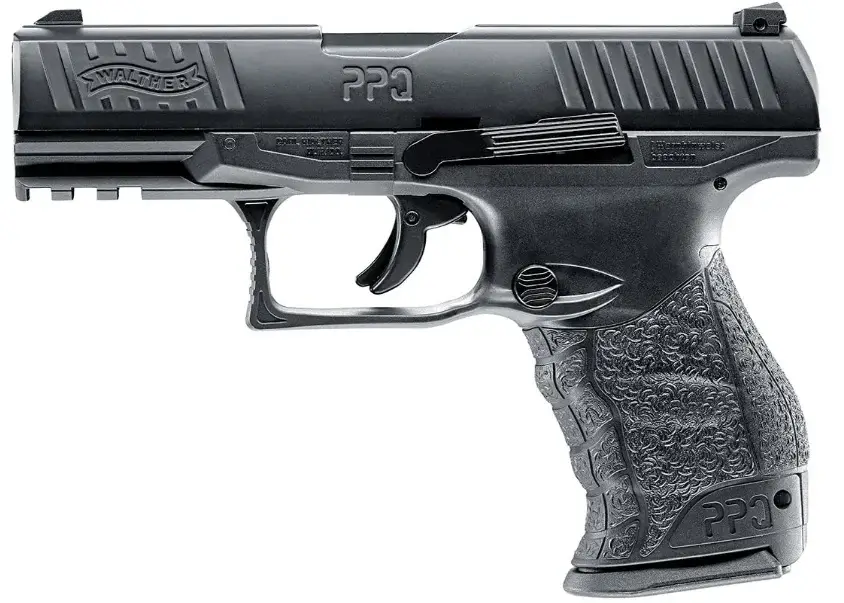
Walther PPQ M2
Caliber: .43 Action: Semi automatic CO₂: 12g CO₂ Capacity: 8 Key Characteristic: Metal slide and distinctive grip Best For: Best .43 alternative
How Paintball Pistols Differ by Caliber
Caliber changes more than the number printed on the box. It affects projectile compatibility, magazine design, pistol proportions, and the type of platform available.
For this guide, the meaningful choices are .43, .50, and .68 caliber.
.43 Caliber Paintball Pistols
A .43 paintball pistol uses a noticeably smaller projectile than a standard .68 caliber paintball pistol.
That smaller format works particularly well with realistic pistol replicas. Three models in this guide use .43 caliber: the GLOCK 17 Gen5, Walther PPQ M2, and Smith & Wesson M&P9 M2.0.
All three use 8-round magazines and 12g CO₂. The GLOCK places both the projectiles and CO₂ cartridge inside its magazine. The Walther follows a similar arrangement.
This caliber makes sense if realistic dimensions, familiar controls, and compact magazine loading matter to you.
The tradeoff is ammunition compatibility. A .43 caliber paintball pistol needs .43 caliber paint. Your bag of .68 paint from another setup will not magically shrink because you ask nicely.
.50 Caliber Paintball Pistols and Revolvers
The .50 caliber category sits between .43 and .68 by projectile diameter.
In our five-pistol lineup, the main reason to consider it is the TR50 Gen 2. Instead of using a conventional detachable pistol magazine, it loads six .50 caliber rounds into a removable rotary magazine.
That makes the TR50 especially relevant for anyone specifically searching for a paintball revolver, 50 cal paintball pistol, or .50 cal paintball revolver.
The CO₂ cartridge sits inside the grip and uses Umarex’s Quick Piercing system. This means the gas cartridge can remain unpierced until the pistol is prepared for use.
.68 Caliber Paintball Pistols
The .68 paintball pistol category gives you compatibility with the standard .68 caliber paint format used widely across paintball.
Among our five picks, the Tippmann TiPX represents this category.
Its design proves that full-size .68 paint does not automatically require a bulky conventional marker. Tippmann built the TiPX around a compact pistol frame, seven-ball magazine, and under-barrel 12g CO₂ system.
This is an important distinction for buyers searching for a small paintball gun or compact paintball gun. Compact describes the platform, not necessarily the projectile.
Choose .43 when realistic pistol dimensions and replica handling are priorities.
Choose .50 when you specifically want the revolver-style TR50 platform.
Choose .68 when standard .68 paint compatibility matters most.
5 Best Paintball Pistols Reviewed
A specification sheet tells you what a pistol contains. It does not tell you what those specifications mean once you load a magazine and actually have to live with the design.
That is how we approached these five picks at Paintball Renegade.
1. Tippmann TiPX Paintball Pistol: Best Paintball Pistol Overall
Some players want pistol dimensions without abandoning .68 caliber paint. That is the situation where the TiPX starts making sense.
The Tippmann TiPX combines a semi-automatic action with a seven-ball magazine and an under-barrel 12g CO₂ system. Tippmann describes it as compact and lightweight, while its manual lists an unloaded weight of 1.81 pounds.
What the TiPX Feels Like in Real Use
Its biggest practical advantage is separation between the magazine and CO₂ source.
The magazine carries paint. The cartridge sits under the barrel.
That means changing magazines does not automatically mean handling a new gas cartridge. For players moving between several magazines, that is simpler than systems where both paint and CO₂ live inside each magazine.
You also get external velocity adjustment. That matters because paintball fields normally require you to chronograph before play rather than assuming a factory setting is suitable.
What the TiPX Does Best
The TiPX stands out because it combines a compact pistol frame with standard .68 caliber paint.
Its separate magazine and CO₂ system also keeps magazine changes straightforward. Adjustable velocity adds another practical advantage when preparing the pistol for field limits.
Best for: Buyers who want a compact, semi-automatic .68 caliber paintball pistol.
Not ideal for: Buyers who mainly want realistic GLOCK, Walther, or Smith & Wesson replica handling.
Verdict: The TiPX is the strongest all-around choice here. It gives paintball pistol buyers a useful balance of standard .68 paint compatibility, manageable size, established magazines, and adjustable performance.
2. T4E GLOCK 17 Gen5 .43: Best GLOCK Paintball Pistol
Sometimes the buying decision starts with a very specific thought: “I want a paintball GLOCK.”
If that is you, generic pistol recommendations are not particularly helpful.
The T4E GLOCK 17 Gen5 is an officially licensed .43 caliber GLOCK paintball pistol replica. Umarex lists an 8-round magazine, 12g CO₂ power source, semi-automatic action, and 1.60-pound weight.
Why the GLOCK Feels Different
Realism is the point.
The pistol uses a CNC-machined aluminum slide with blowback operation, a polymer frame, ambidextrous slide stop, and reversible magazine release.
That moving slide gives each shot more mechanical feedback than a non-blowback pistol. It feels livelier in the hand.
There is a cost to that experience. Blowback consumes gas because some CO₂ must cycle the slide rather than only propel the paintball.
The 8-round magazine also houses the 12-gram CO₂ cartridge. That creates a very different loading experience from the TiPX.
The Appeal Goes Beyond the GLOCK Logo
The dimensions and controls matter more than branding alone.
Umarex lists compatibility with GLOCK sights, holsters, and numerous aftermarket components. That can be valuable for buyers who care about familiar handling and replica-specific accessories.
Marketplace feedback supplied for this guide reflects that appeal. Owners commonly praise the realistic look and feel.
Feedback becomes more mixed around performance, magazine design, and value.
That distinction matters. You are buying a pistol where replica authenticity is a major part of the experience.
Who Should Skip It?
Do not choose the GLOCK simply because it looks impressive in photos.
If your priority is .68 caliber paint, the TiPX fits that requirement better.
Likewise, buyers who care more about uncomplicated paintball performance than replica realism may not value the extra engineering tied to licensed dimensions and blowback operation.
Community discussions make a similar distinction. Some owners love the realistic scale and accessory compatibility, while others prefer purpose-built paintball pistols when field performance matters more than replica feel.
Best for: Anyone specifically searching for a paintball pistol GLOCK, GLOCK paintball gun, or realistic GLOCK .43 paintball platform.
Not ideal for: Buyers who prioritize .68 paint compatibility over replica handling.
Verdict: Choose the GLOCK 17 Gen5 T4E because you want the GLOCK experience in a .43 paintball pistol. If realism is not important, its biggest advantage becomes much less meaningful.
3. Umarex T4E Walther PPQ M2 .43: Best .43 Caliber Alternative
Not everyone finds the same grip comfortable.
That becomes obvious once a pistol stays in your hand for more than a few minutes.
The Walther PPQ M2 gives buyers another serious .43 caliber paintball pistol without simply copying the GLOCK experience.
Umarex specifies an 8-round drop-free magazine, 12-gram CO₂ housed in the magazine, semi-automatic operation, blowback action, integrated Picatinny rail, and metal slide.
Where the PPQ M2 Stands Out
Grip design is the most interesting difference.
Walther pistols are known for a contoured grip shape, and Umarex specifically highlights grip feel on the PPQ M2 T4E.
For the buyer, that translates into a simple question: does the grip naturally sit where you want it?
Controls that technically work well can still feel awkward when the grip shape does not suit your hand.
The PPQ also has a drop-free magazine and visible blowback movement. The magazine carries both the eight projectiles and the CO₂ cartridge.
This creates a compact, self-contained magazine system, but spare magazines become more mechanically substantial than simple paint-only magazines.
Practical Limitations
The PPQ remains a .43 caliber platform.
If your local paintball setup revolves around .68 paint, you must maintain separate ammunition.
Blowback also spends gas on slide movement. Buyers expecting every bit of CO₂ to go directly toward projectile propulsion should understand that tradeoff.
Best for: Buyers wanting a realistic .43 paintball pistol who prefer Walther ergonomics.
Not ideal for: Someone who wants standard .68 caliber paint compatibility or the smallest possible number of ammunition types to keep around.
Verdict: The PPQ M2 is a strong alternative to the GLOCK when grip feel matters more than the badge on the slide.
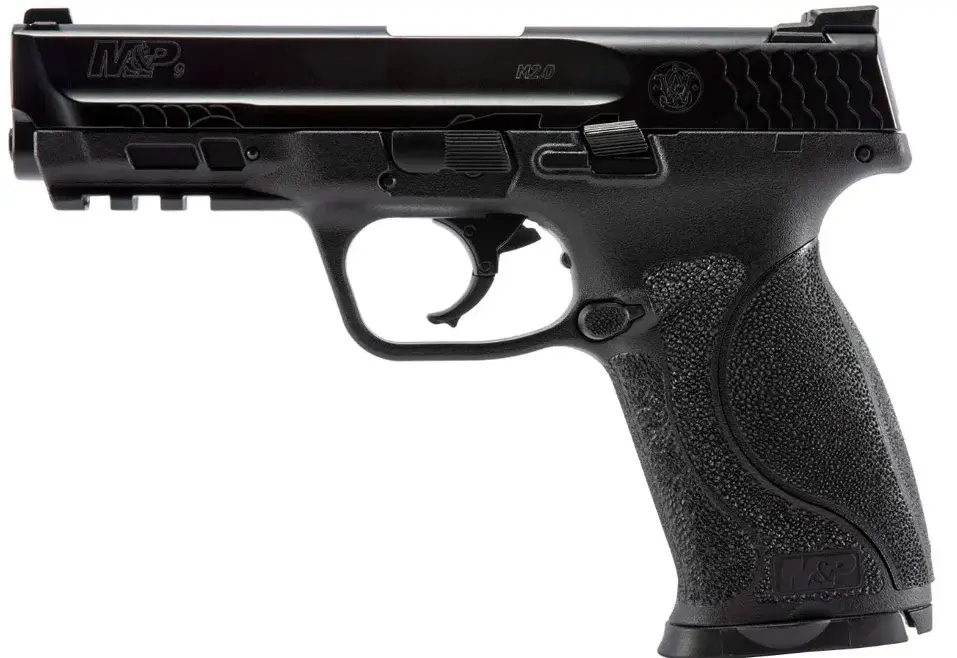
4. T4E Smith & Wesson M&P9 M2.0 .43: Best for Pistol Ergonomics
A pistol can have excellent specifications and still feel wrong in your hand.
The Smith & Wesson M&P9 M2.0 T4E addresses that issue through familiar M&P controls and grip geometry.
This paintball handgun uses .43 caliber paint, an 8-round magazine, a 12g CO₂ cartridge, and blowback operation. Umarex lists a 355 FPS velocity and notes that the controls and ergonomics closely mirror the corresponding pistol platform.
What You Notice First
The M&P is less about one dramatic specification and more about the total handling package.
Grip shape, trigger reach, magazine release placement, and balance all influence how naturally a pistol points.
That is why this model makes sense for someone who already prefers M&P-style ergonomics.
The blowback slide provides movement with each shot. For some users, that mechanical feedback makes the pistol feel more engaging.
For others, it is simply another system consuming CO₂.
Neither view is wrong.
Real World Feedback Is Strong, But Not Perfect
The marketplace information supplied for this guide shows a large number of reviews and a strong overall rating.
That is useful, but ratings should never replace checking whether the product suits your specific caliber and handling preferences.
A popular .43 pistol is still the wrong purchase if you want .68 paint compatibility.
GLOCK vs Walther vs S&W .43 Pistols
These three share enough hardware concepts that the best decision often comes down to how you want the pistol to feel.
| Model | Main Ergonomic Character | Capacity | CO₂ Location | Action | Main Reason to Choose |
| GLOCK 17 Gen5 | Familiar GLOCK controls | 8 | Magazine | Blowback | Licensed GLOCK realism |
| Walther PPQ M2 | Contoured Walther grip | 8 | Magazine | Blowback | Grip feel |
| S&W M&P9 M2.0 | M&P style ergonomics | 8 | Magazine | Blowback | Familiar handling |
All three operate in the same .43 caliber family. That makes fit and control layout far more useful deciding factors than trying to crown one universally superior.
Best for: Buyers who like M&P grip geometry and want a compact CO₂ pistol with realistic controls.
Not ideal for: Buyers who do not care about replica ergonomics or want .68 caliber paint.
Verdict: Pick the M&P9 M2.0 when hand fit and control familiarity matter more to you than GLOCK branding or Walther grip geometry.
5. T4E TR50 Gen 2 .50 Caliber: Best Paintball Revolver
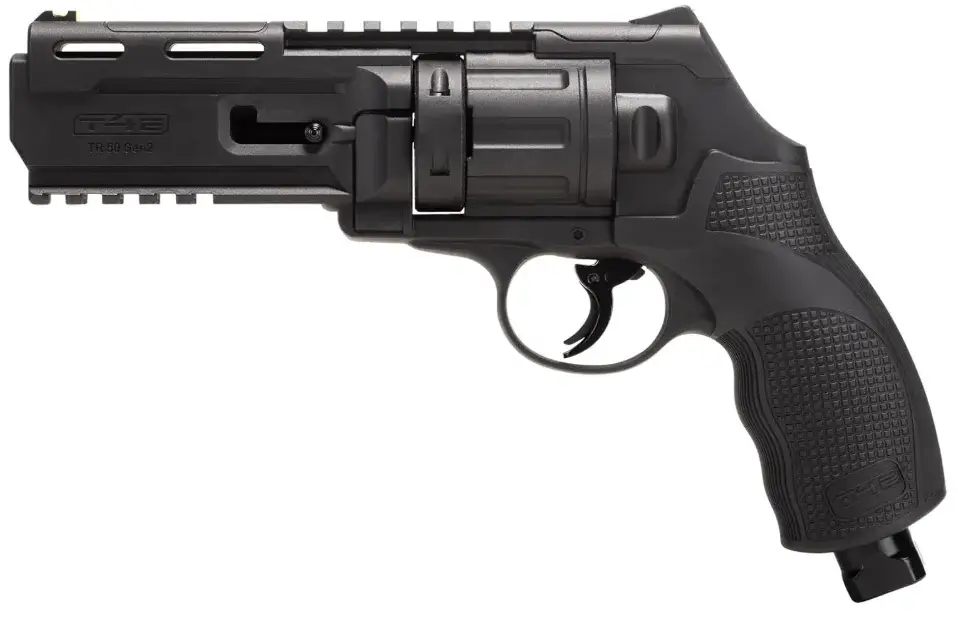
A revolver solves the loading problem differently.
Instead of feeding paint from a conventional pistol magazine, the TR50 Gen 2 uses removable six-round rotary magazines behind a stationary cylinder.
That immediately gives it a different rhythm from every semi-automatic pistol above.
Umarex currently lists the TR50 Gen 2 as a .50 caliber, six-round revolver powered by one 12g CO₂ capsule inside the grip. Its current specification states 380 FPS.
What the Revolver Format Changes
Loading is simple to understand.
The rotary magazine carries six .50 caliber rounds. Once empty, you remove it and replace it with another loaded cylinder.
The CO₂ stays inside the pistol grip.
That means changing paint and changing gas are separate tasks, somewhat like the TiPX concept but with a completely different ammunition system.
The Gen 2 also uses an improved tool-free Quick Piercing mechanism. The cartridge can sit inside the grip without being pierced until the system is activated.
Paintball Revolver vs Semi-Automatic Paintball Pistol
A paintball revolver is not simply a semi-automatic pistol wearing a different body.
The TR50 uses:
- A six-round rotary magazine
- A revolver action
- CO₂ stored in the grip
- Separate cylinder changes for ammunition
- A larger, distinctive frame
The GLOCK, PPQ, and M&P instead use detachable eight-round pistol magazines with blowback slides.
Neither approach is inherently better.
The revolver rewards buyers who specifically want the cylinder system and .50 caliber format.
The Tradeoff
Six rounds disappear quickly.
Rotary magazines are easy to understand, but they do not provide the same drop-free pistol magazine experience as the .43 models.
Marketplace feedback supplied for this guide also mentions occasional CO₂ leakage concerns. That makes seal care worth taking seriously.
There is another important point for secondhand buyers.
Umarex currently has a recall notice covering certain earlier TR50 model numbers and serial ranges because a CO₂ cartridge could eject with force. The recall notice lists models 2292112, 2280182, and 2280199. The current Gen 2 product page uses SKU 2292176. Anyone buying an older used TR50 should check the model and serial number before using it.
Best for: Buyers specifically looking for a .50 cal paintball revolver with removable rotary magazines.
Not ideal for: Someone who wants GLOCK-style controls, an eight-round drop-free magazine, or .68 caliber paint.
Verdict: The TR50 Gen 2 is the clear choice among these five when the revolver format itself is what attracts you.
Which Paintball Pistol Should You Choose?
Your choice should start with caliber and pistol style.
The Tippmann TiPX is our best overall pick for buyers who want a compact .68 caliber pistol. Choose the T4E GLOCK 17 Gen5, Walther PPQ M2, or S&W M&P9 M2.0 if realistic .43 caliber replica handling matters more.
For buyers specifically looking for a paintball revolver, the T4E TR50 Gen 2 is the clear option in this group.
So, what is the best paintball pistol? For the broadest paintball-focused use among these five, we would choose the Tippmann TiPX.
What to Check Before Buying a Paintball Pistol
Finding a paintball pistol for sale is easy. Finding one that matches your ammunition, field rules, hand size, and expectations takes more thought.
A few checks can prevent an expensive “well, that was not what I expected” moment.
Choose the Caliber First
Decide whether you need .43, .50, or .68 before comparing cosmetic features.
These calibers are not interchangeable, so consider the paint you already use and what your field accepts. The earlier caliber comparison explains the practical differences between all three.
Check Magazine or Cylinder Capacity
Capacity matters more with pistols because every model here carries fewer than ten rounds.
Beyond the number itself, check how quickly the magazine or cylinder reloads and whether affordable spare magazines are readily available.
A good pistol becomes frustrating quickly when one magazine keeps you at the loading table more than the field.
Understand Where the CO₂ Cartridge Sits
CO₂ placement changes how the pistol feels and how you handle reloads.
Some models integrate the cartridge into the magazine, while others keep it inside the pistol or grip. Consider which arrangement feels simpler for the way you plan to use the pistol.
These products use compact 12g CO₂ cartridges rather than conventional external paintball tanks.
Size, Weight, and Grip Shape
Searches such as small paintball gun, mini paintball gun, compact paintball gun, and lightweight paintball gun usually point to the same underlying problem.
Buyers want something manageable.
Overall length matters, but so do:
- Loaded weight
- Grip circumference
- Trigger reach
- Balance
- Magazine weight
- Control placement
A pistol can be short yet still feel heavy or awkward.
If possible, handle the model before buying. If not, compare official measurements instead of relying only on marketplace dimensions, which are sometimes package measurements rather than actual product size.
Check Field Compatibility Before Buying
Do not assume every field accepts every caliber or realistic replica design.
Ask your field about:
- Accepted paintball calibers
- Velocity limits
- Chronograph requirements
- Replica pistol rules
- Required paint types
The TiPX manual specifically instructs users to measure velocity before play and not exceed 300 FPS. Your actual field may set a lower limit.
A beautiful pistol that cannot be used where you play is basically a very complicated shelf decoration.
CO₂ Efficiency and Pistol Performance
CO₂ gives these compact pistols enough energy without attaching a large external air system.
It also introduces variables that buyers should understand.
One 12g Cartridge Does Not Equal One Fixed Shot Count
CO₂ efficiency changes according to:
- Pistol design
- Blowback operation
- Temperature
- Firing speed
- Seal condition
- Cartridge quality
- Velocity setting where adjustable
Tippmann’s TiPX manual estimates about 19 shots from one 12-gram cartridge. Umarex advertises up to 90 shots from one cartridge for the .43 caliber GLOCK 17 Gen5. Those numbers are not directly comparable because the pistols use different calibers, actions, and gas systems.
Cold Weather Matters
CO₂ pressure drops as temperature falls.
The practical result can be reduced consistency and fewer useful shots from a cartridge.
Rapid firing can also cool the cartridge and pistol further.
If you regularly play in cold conditions, do not evaluate a CO₂ paintball pistol only by its warm-weather specifications.
FPS Is Only One Part of Performance
Higher FPS does not automatically mean a better paintball handgun.
A useful pistol also needs:
- Consistent velocity
- Reliable feeding
- Paint that fits the barrel and magazine
- Predictable trigger response
- Comfortable handling
Accuracy is a system, not one number.
A pistol that launches every ball fast but sends them to three different zip codes is not winning the argument.
Paintball Pistol Maintenance: Preventing Leaks and Paint Breaks
Compact CO₂ systems place seals, magazines, and valves under repeated pressure.
A little maintenance can prevent many annoying problems.
Keep CO₂ Seals Healthy
Inspect O-rings and seals periodically.
If the pistol begins hissing after cartridge installation, stop and identify the leak rather than repeatedly firing and hoping it develops better manners.
Use only lubricants recommended by the manufacturer.
Petroleum-based products can damage some seals and should not be used unless the manufacturer specifically approves them.
Do Not Leave CO₂ Installed Indefinitely
Follow the manufacturer’s storage instructions.
Keeping unnecessary pressure on seals for long periods can accelerate wear in some systems.
Remove cartridges safely according to the pistol manual.
Clean Broken Paint Quickly
A paintball break inside a short pistol barrel can ruin the next several shots.
Clean the barrel before continuing.
Also inspect the magazine or rotary cylinder if paint has leaked into the feeding area.
Sticky paint plus a magazine spring is not a recipe for reliable feeding.
Watch the Magazine
Pistol magazines do more work than many buyers realize.
Depending on the model, the magazine may contain:
- Paint
- Feed spring
- Follower
- CO₂ cartridge
- Piercing mechanism
- Gas seals
Keep feed channels clean and inspect lips, followers, springs, and seals for damage.
Common Paintball Pistol Problems
CO₂ leaking from the magazine often points toward cartridge seating or seal issues.
A leak from the grip or chamber may involve the cartridge seal or piercing assembly.
Poor feeding can come from dirty magazines, damaged paint, incorrect ammunition, or spring issues.
Weak blowback can appear when gas pressure drops.
A TR50 rotary magazine that does not index correctly deserves inspection before more paint is loaded.
When a problem persists, use the official manual or manufacturer support instead of forcing components.
Common Paintball Pistol Buying Mistakes
Most disappointing purchases come from mismatched expectations rather than terrible products.
Choosing a Replica Only Because It Looks Good
The GLOCK, Walther, and S&W pistols offer realistic styling.
That does not automatically make them a better match than a purpose-built .68 TiPX.
Decide whether you value replica handling or paintball-focused compatibility more.
Ignoring Spare Magazines
Limited capacity is part of pistol play.
One magazine can turn a fun setup into a constant loading session.
Check magazine availability before committing to a model.
Trusting Every Marketplace Specification
Marketplace listings sometimes combine package dimensions, incorrect weights, or outdated specifications.
For example, the supplied marketplace data lists the GLOCK at 12 grams, while Umarex’s current official specification lists the pistol at 1.60 pounds.
Use the manufacturer as the primary source when specifications conflict.
Assuming Every Pistol Has Adjustable Velocity
Do not make this assumption.
The TiPX provides velocity adjustment, but different T4E pistols use different factory performance specifications.
Know what your field requires before buying.
Ignoring CO₂ Maintenance
A good pistol with neglected seals quickly becomes a bad afternoon.
CO₂ cartridges, piercing mechanisms, seals, O-rings, and magazines are part of ownership.
Factor maintenance into your decision.
Forgetting Local and Field Rules
Realistic replicas can attract stricter rules than colorful conventional paintball equipment.
Check local regulations, transport requirements, and field policies.
Never brandish or display a realistic paintball pistol in public.
Final Verdict
For us, the Tippmann TiPX remains the best paintball pistol overall because it combines compact handling, semi-automatic operation, and .68 caliber compatibility.
The better choice for you still depends on caliber, grip, magazine design, and whether you prefer paintball-focused performance or realistic replica handling.