Disclaimer: This article reflects general product research, buyer feedback, and hands-on paintball experience. It is not a substitute for reading your marker’s manual or your local field’s safety rules before playing.
My first paintball marker was a hand-me-down with a sticky trigger and a hopper that jammed every third shot. I spent more time picking dead paint out of the breech than actually playing, and by the end of that day I was ready to hang up the mask for good. It wasn’t the sport that let me down. It was the gun.
That’s the thing nobody tells new players. Buying your first paintball gun is a completely different job than buying an upgrade later. You’re not chasing tournament specs or the fastest cyclic rate. You need something that shoots straight, doesn’t fight you, and lets you actually learn the game instead of babysitting equipment.
The “best” beginner marker isn’t one single gun. It depends on how you plan to play, what kind of budget you’re working with, and whether you want a complete setup handed to you or a solid marker you build around. This guide walks through five markers I’d genuinely recommend to a first-time player, and how to think through the decision for your own situation.
What Makes a Paintball Gun Good for Beginners?
Before getting into specific markers, it helps to understand what separates a genuinely beginner-friendly gun from one that just gets marketed that way. Spec sheets don’t tell you how a marker behaves when your hands are shaking, and someone just called your name from across the field.
The First Marker Should Teach You Paintball, Not Fight You
A good beginner marker gets out of your way. The trigger should be easy to work without a hair-trigger pull that dumps your whole hopper by accident. Controls should be obvious, not buried behind a menu of settings you don’t understand yet.
Comfort matters more than people expect. A marker that feels awkward in your hands after twenty minutes will wear you down long before your legs do. New players already have enough to think about between bunkers, sight lines, and remembering which way is “up” on the mask.
The goal early on is simple: less time fixing gear, more time actually playing. Every minute spent troubleshooting a jam is a minute you’re not learning positioning, movement, or how to read the field. A forgiving marker lets the learning curve be about paintball, not about the equipment itself.
Why Reliability Matters More Than Advanced Features
A marker that shoots consistently, game after game, builds confidence fast. One that misfires or chops paint erodes it just as quickly. New players don’t need a long feature list. They need a gun that does the same thing every single time they pull the trigger.
Durable construction matters here too. Beginners drop gear, bang it against bunkers, and generally treat equipment rougher than they mean to. A marker built with fewer fragile parts tends to survive that learning phase without needing constant repairs.
There’s a confidence factor that’s easy to overlook. Players who trust their gun play looser and more aggressively. Players who are worried about a jam tend to hang back, second-guess shots, and have a worse time overall. Reliability isn’t a bonus feature. It’s the foundation everything else sits on.
Cheap Does Not Always Mean Beginner-Friendly
The cheapest marker on the shelf isn’t automatically the smartest first purchase. Rock-bottom pricing sometimes means thinner materials, unreliable internals, or parts that are hard to find once something breaks. That turns into frustration fast, and frustration is what makes people quit the sport in month one.
It helps to think about total ownership, not just the sticker on day one. A marker from a brand with wide parts availability and community support will be far easier to live with a year from now. Replacement o-rings, bolts, and springs should be easy to source, not a scavenger hunt on obscure forums.
There’s also an upgrade path worth considering. A marker that can grow with you, even a little, saves you from replacing your entire setup the moment you get serious about the game. Value beats “cheap” almost every time in this hobby.
The 5 Best Beginner Paintball Guns Compared
Here’s a quick side-by-side of the five markers covered in this guide. Full breakdowns, including who each one actually fits, follow right after the table.
| Marker | Best For | Playing Style | Air System | Beginner Rating | Main Advantage |
| Planet Eclipse EMEK 100 | Players who want a marker they won’t outgrow | Recreational, casual fields | Compressed air only | 9.5/10 | Mechanical simplicity, no batteries |
| Maddog Tippmann Cronus Starter Package | First-time buyers who want everything included | Casual, backyard, weekend fields | CO2 or HPA | 9/10 | Complete starter kit convenience |
| Empire Mini GS | Beginners curious about electronic markers | Recreational, with room to grow | CO2 (runs best on compressed air long term) | 8.5/10 | Lightweight with adjustable firing modes |
| Dye Rize CZR | New players planning to improve quickly | Recreational, headed toward serious play | Compressed air | 8/10 | High-end features at an entry price point |
| Tippmann Stormer Elite | Beginners who like customizing gear | Casual outdoor, scenario-style games | HPA air tank | 8/10 | Dual-fed flexibility, four rail mounts |
1. Planet Eclipse EMEK 100: Best Overall Beginner Paintball Marker

Picture this scenario. You’ve played a couple of rental days, you’re hooked, and now you want a marker that won’t need replacing the second you start playing regularly. That’s exactly who the EMEK 100 was built for.
Why the EMEK 100 Works So Well for New Players
The EMEK 100 runs on the Gamma Core drivetrain, a purely mechanical, pneumatic firing system. No batteries, no boards, no menus to learn. You set your velocity, flip the safety, and go play, which is about as close to plug-and-play as a real paintball marker gets.
In practice, that translates to a marker that fires the moment you pull the trigger, shot after shot, without hesitation. Buyers consistently describe it shooting balls one after another in a straight line, and note it keeps up as fast as they can physically pull the trigger. Accuracy holds up well too, with players reporting solid hits out to roughly 50 yards.
Low operating pressure and a smooth bolt design also mean fewer broken paintballs inside the marker itself, which is one of the more annoying beginner headaches. Fewer breaks means less mid-game cleaning and more time actually playing. One reviewer went as far as calling it more durable than steel, which is a fun bit of hyperbole, but it does speak to how tough this thing feels in hand.
The trade-off is that the EMEK 100 is a bare marker, not a kit. It doesn’t include a mask, hopper, or tank, so you’ll need to build the rest of your loadout separately. Compared to an all-in-one package, that’s more shopping upfront, but it also means you’re not stuck with budget accessories bundled in just to hit a price point.
Who Should Choose the EMEK 100?
This marker makes the most sense for players who plan to hit the field regularly, not just once or twice a summer. If you already know you like paintball and want gear that respects that decision, the EMEK 100 is a smart, low-drama choice.
It’s not the best fit if you want everything handed to you in one box on day one. If convenience matters more than long-term value right now, the Cronus package below might suit you better. But if you’d rather buy once and buy right, this is my top overall pick for a first marker.
2. Maddog Tippmann Cronus Package: Best Beginner Paintball Gun Starter Kit
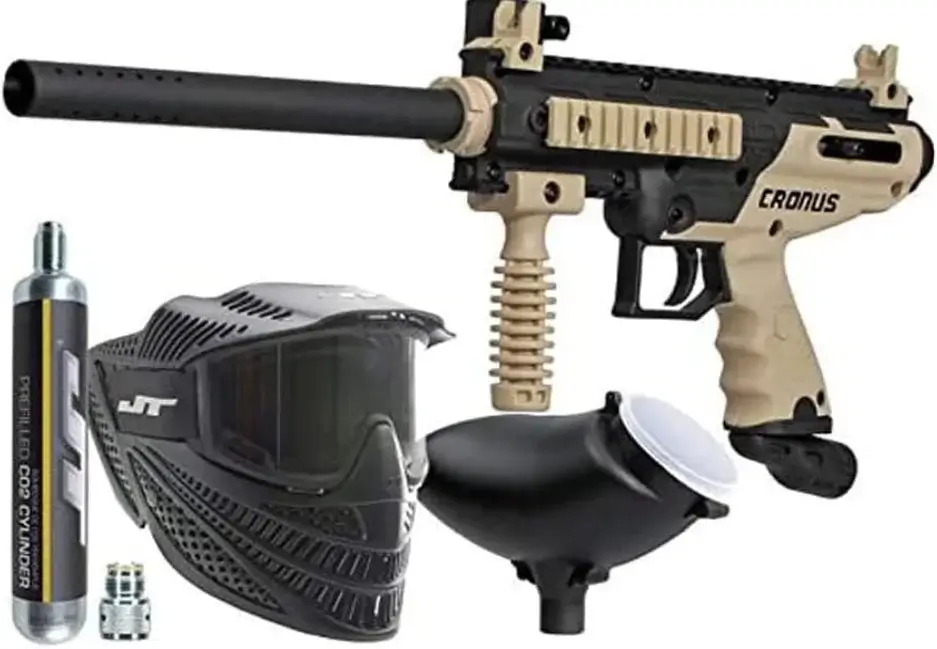
Now imagine the opposite problem. You want to play this weekend, you own nothing, and the idea of researching masks, hoppers, and tanks separately sounds exhausting. That’s the gap this package fills.
Why the Cronus Package Is Popular With First-Time Players
The Maddog bundle wraps the Tippmann Cronus marker together with a mask, a 200-round hopper, a CO2 tank, and a barrel squeegee. Everything needed for a first day on the field, aside from paint itself, shows up in one box. For someone who has never owned a stitch of gear, that’s genuinely useful.
Buyers frequently mention it as a solid gift or starter purchase for someone brand new to the sport, describing it as a “perfect starter gun” for a player who’s still learning the ropes. The in-line bolt design and high-impact composite body also hold up to the inevitable bumps and drops that come with a first season of play.
One detail worth knowing before you buy: the tank ships empty. You’ll need to get it filled at a field or pro shop before your first game, which trips up a surprising number of first-time buyers who assume it arrives ready to shoot.
Where the Cronus Makes Sense (and Where It Does Not)
The obvious upside here is convenience. You’re not piecing together a loadout from five different listings, hoping everything matches. It’s also genuinely durable for the category, and easy enough to understand that you can be shooting confidently within your first hour of ownership.
That said, it’s worth setting expectations honestly. Some players find the marker on the heavier side, and the trigger pull is mechanical rather than the lighter, tunable feel of an electronic setup. One detailed buyer review noted the barrel bore runs slightly undersized at 685, which improves accuracy but means you’ll get outgeared on the field if you’re playing against upgraded electronic markers. None of that ruins the experience for casual play, but it’s a real trade-off compared to markers built with performance as the priority from day one.
3. Empire Mini GS: Best Beginner Electronic Paintball Marker
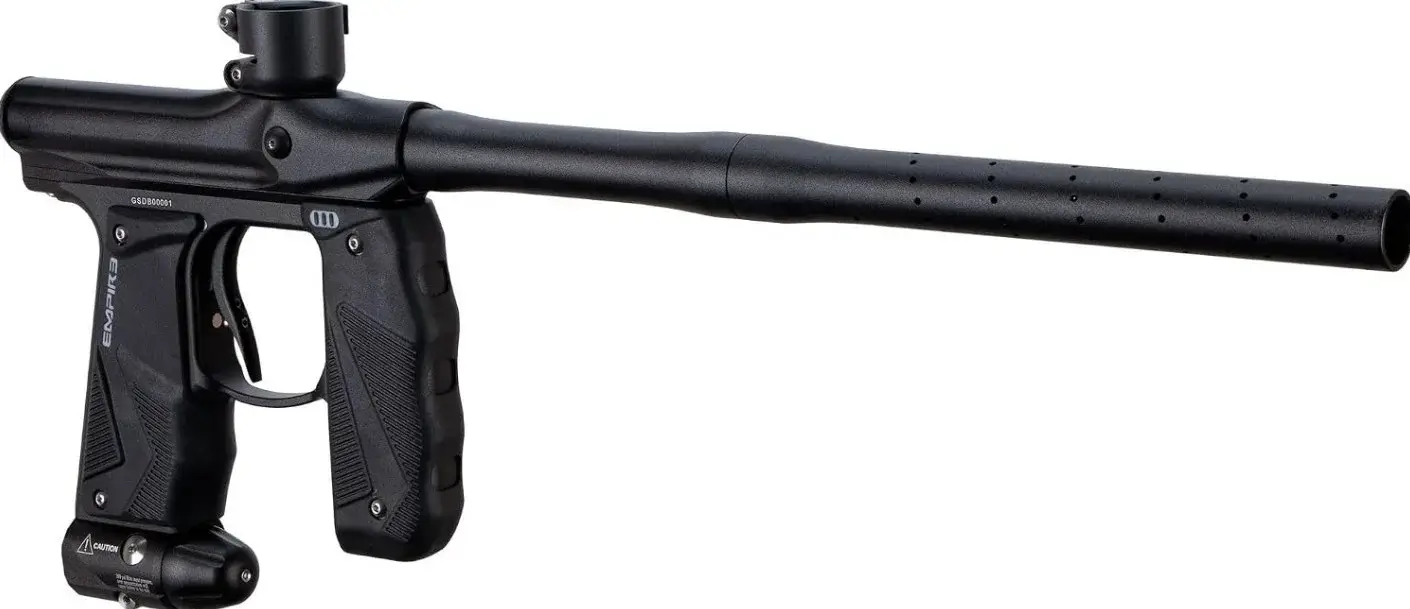
Some beginners skip past mechanical markers entirely and want to know what all the fuss is about with electronics. If that’s you, the Mini GS is a reasonable place to start without jumping into deep-end pricing.
Why Some Beginners Prefer Electronic Markers
Electronic markers respond to trigger pulls with less physical effort, which some new players find easier on the hand during a long day. The Mini GS also lets you switch between firing modes, giving you a taste of the adjustability that electronic platforms are known for, without needing a separate performance board.
Buyers describe it as easy to program and performing well right out of the box, which matters a lot for someone who doesn’t want to spend their first weekend reading a manual. It’s also noticeably light for a metal-framed marker, which helps during longer games.
Is the Empire Mini GS Too Advanced for a New Player?
Not really, but there are a couple of things to know going in. Electronic markers need a battery, and running out of charge mid-game is a rookie mistake almost everyone makes exactly once. Keep a spare on hand, and it stops being an issue.
Some buyers have reported air leakage and screws that strip during routine cleaning, which is worth knowing before you buy so it doesn’t catch you off guard. It’s also worth noting that while this marker lists CO2 compatibility, electronic internals generally hold up better long-term on compressed air rather than liquid CO2, so plenty of owners switch tanks once they have field access to HPA fills.
If the idea of a battery, charging, and slightly more moving parts feels like one more thing to manage while you’re still learning the basics, skip this one for now and start mechanical instead. If you’re the type who likes gadgets and wants to feel the difference electronics make, this is a fair, low-risk way to try it.
4. Dye Rize CZR: Best Beginner Marker for Players Planning to Improve
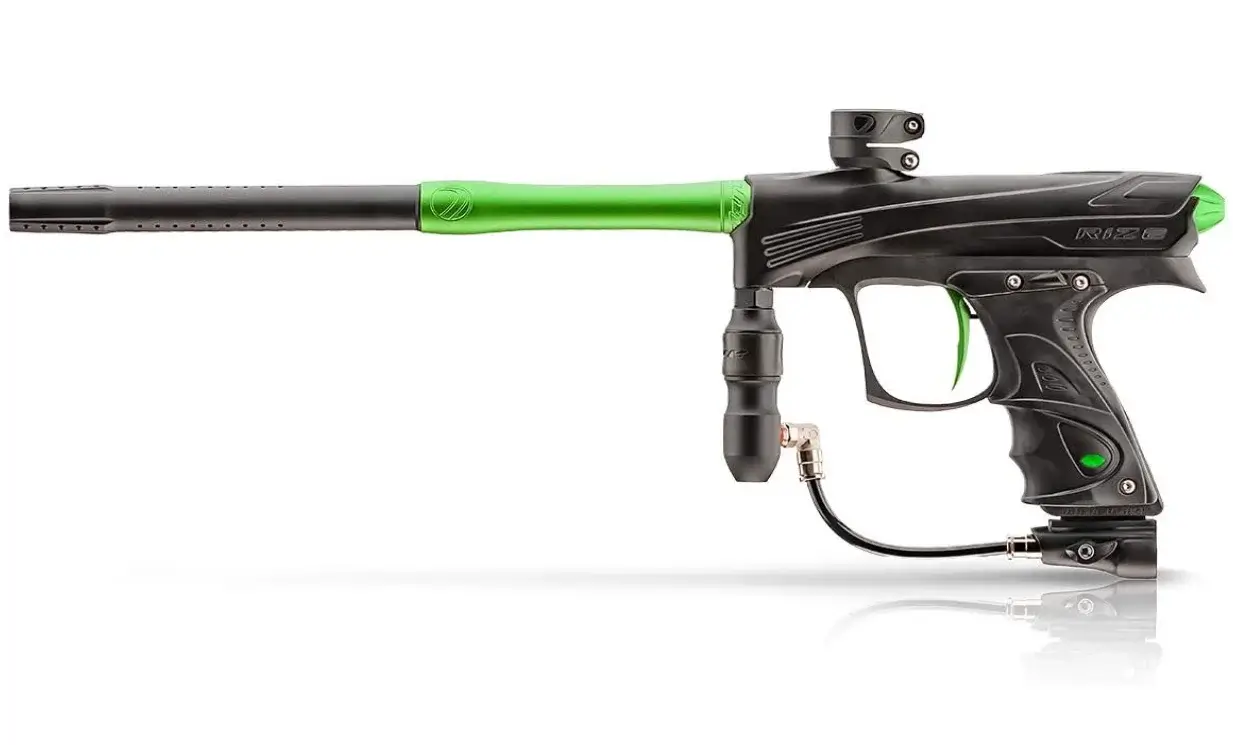
Some new players already know they’re not going to stay casual for long. If you’re the type who researches everything before buying a single item, and you can already picture yourself playing every weekend, this section is for you.
Features That Help New Players Improve
The CZR packs in a two-piece True Core barrel, a proven regulator, and internal anti-chop eyes, all of which are features usually reserved for markers a tier above entry-level. In plain terms, that means fewer broken paintballs inside the gun and shot consistency that holds up as your skills improve.
The self-cleaning eye pipe and screw-together bolt design also keep maintenance simple despite the more advanced internals. That’s a nice bit of engineering, since it means you get performance features without the maintenance headache that usually comes attached to them. A full parts kit, lube, and tools ship in the box, which is a thoughtful touch for someone building their first real understanding of marker upkeep.
Why It May Not Be the First Choice for Casual Players
Reviews on this marker are genuinely mixed. Some buyers report a solid, reliable unit, while others describe defective units straight out of the box or a gun that stopped functioning after minimal use. That inconsistency is worth factoring in, and I’d recommend testing it thoroughly the first time you fill it, well before your first real game day.
Compared to a straightforward mechanical option like the EMEK 100, the CZR asks more of you as an owner. It’s a marker built for someone who wants to grow into advanced play quickly, not someone who just wants to shoot paint on weekends without thinking too hard about it. If that’s not you yet, it’s fine to wait.
5. Tippmann Stormer Elite: Best Beginner Marker for Customization
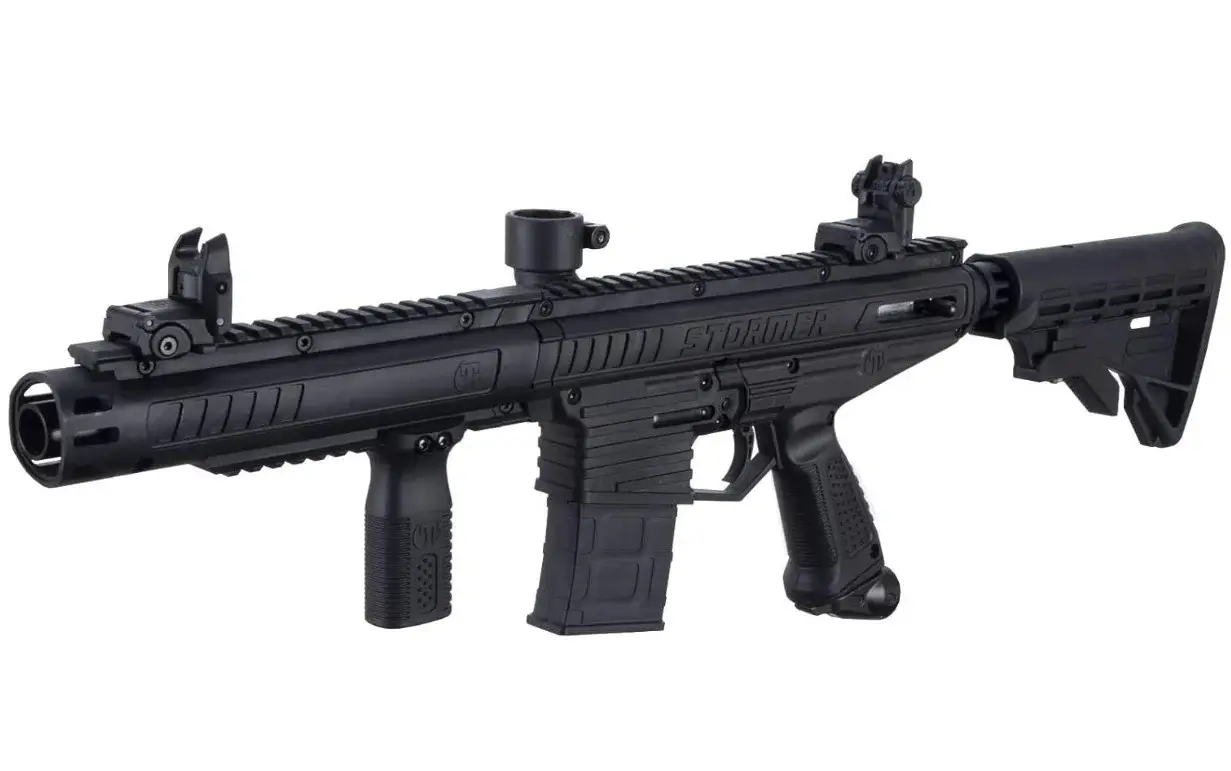
Then there’s the player who treats gear like a hobby within the hobby. If tinkering, swapping accessories, and building a personalized setup sounds fun rather than tedious, keep reading.
What Makes the Stormer Elite Different?
The Stormer Elite ships with a dual-fed design, meaning it can run off a standard hopper or switch over to magazine feeding using the included 20-round mags. That flexibility alone sets it apart from most markers in this price range, letting you experiment with two very different play styles on one platform.
Four Picatinny rails also mean you can mount sights, grips, or a flashlight without needing an aftermarket body swap. Buyers describe it as accurate and durable, with one noting it kept pace firing rounds as fast as they could pull the trigger. The internal air line keeps the exterior clean and reduces snag points, which matters more than people expect once you’re crawling around bunkers.
Who Should Buy the Stormer Elite?
This marker fits players who enjoy casual outdoor games with a bit of tactical flavor, or scenario-style days where switching setups mid-event adds to the fun. If you like the idea of experimenting with your gear as much as playing the game itself, it’s a genuinely enjoyable platform to own.
It’s not the pick for someone who just wants the simplest possible first gun. The dual-fed system adds a small learning curve of its own, and it’s heavier than the EMEK 100 at six pounds. If simplicity is your top priority, look at the EMEK or the Cronus package instead.
What Does a Beginner Actually Need With Their First Paintball Gun?
A marker alone won’t get you through the gate at most fields. Here’s the actual short list of gear you need before your first real game day, and why each piece earns its spot in your bag.
- Paintball mask. Non-negotiable. Look for one certified under the ASTM F1776 standard, and never substitute safety glasses or goggles, since they aren’t rated for direct paintball impact.
- Hopper. Feeds paint into the marker. A basic gravity-fed hopper is plenty for recreational play, and most starter packages already include one.
- Air tank. Either a CO2 tank or a compressed air (HPA) tank, depending on what your marker supports and what your local field fills.
- Paintballs. Sold separately from every marker on this list, and generally cheapest bought in bulk at the field itself or from a local shop.
- Barrel cover or barrel bag. Required by most fields any time your marker isn’t actively in play, as a basic safety rule to prevent accidental discharge.
- Pod pack (optional). A small harness for carrying spare paintballs, more useful once you’re playing longer games or full-day sessions.
Common First-Time Paintball Gun Buying Mistakes
I hear versions of the same three mistakes constantly from readers over at Paintball Renegade. All three are avoidable if you know what to watch for before you buy.
Buying the Cheapest Marker Instead of the Right Marker
The lowest-priced option on a search results page is rarely the smartest first purchase. Off-brand markers often come with poor parts support, which means a single broken o-ring can turn into weeks of waiting on a replacement instead of an easy fix at a local shop.
Choosing Features You Don’t Understand Yet
It’s tempting to buy the marker with the longest feature list, assuming more settings means more value. In reality, unfamiliar features you don’t know how to use yet just add confusion during a phase when you’re already learning enough. Simplicity earns its keep early on.
Forgetting the Cost of Playing Paintball
The marker is just one line item. Paintballs, air fills, and field entry fees add up fast, especially once you’re playing regularly. Replacement parts, like O-rings and bolts, are a normal part of ownership too, not a sign something went wrong. Budgeting for the ongoing cost of playing, not just the gear itself, saves a lot of surprises later.
Beginner Paintball Gun FAQs
What is the best paintball gun for beginners?
The Planet Eclipse EMEK 100 is my top overall pick for most new players, thanks to its mechanical simplicity and long-term reliability. If you’d rather get a complete kit in one purchase, the Tippmann Cronus starter package is the easier all-in-one route.
How much should a beginner spend on a paintball gun?
Rather than chasing the absolute lowest price, put your money toward a marker from a brand with solid parts availability, and don’t skimp on your mask since that’s your eye protection. A complete starter package costs more upfront than a bare marker alone, but it removes the guesswork of piecing together mismatched gear, and often works out to better overall value.
Is a mechanical paintball marker better for beginners?
For most first-time players, yes. Mechanical markers like the EMEK 100 have fewer parts that can fail, don’t require battery management, and tend to be more forgiving of rough handling while you’re still learning. Electronic markers aren’t off-limits; they just ask a little more of a new owner.
Should my first paintball gun use CO2 or compressed air?
Both work fine for casual recreational play. CO2 tends to be more widely available and simpler for beginners, though performance can dip in cold weather. Compressed air (HPA) delivers more consistent shots and is gentler on electronic internals, which is worth considering if your marker has a solenoid.
Can beginners use professional paintball markers?
Technically, yes, but it’s rarely a smart first purchase. Higher-end markers are built around tuning and features that assume you already understand the fundamentals, and the cost of replacement parts tends to climb along with the marker’s price point. Learning on a beginner-friendly marker first, then upgrading once you know what you actually want, is the more practical path.
Final Take
Your first paintball marker doesn’t need to be perfect. It needs to be reliable enough that you keep showing up to play, comfortable enough that you’re not fighting it, and simple enough that you spend your first season learning the game instead of learning your gun’s quirks.
Whichever marker you land on from this list, treat the first few games as practice for reading the field, not proving anything to anyone. That part of paintball, the part where you finally stop flinching at incoming fire, comes with time on the field, not with a spec sheet. That’s the whole reason a page like this exists on Paintball Renegade in the first place.