
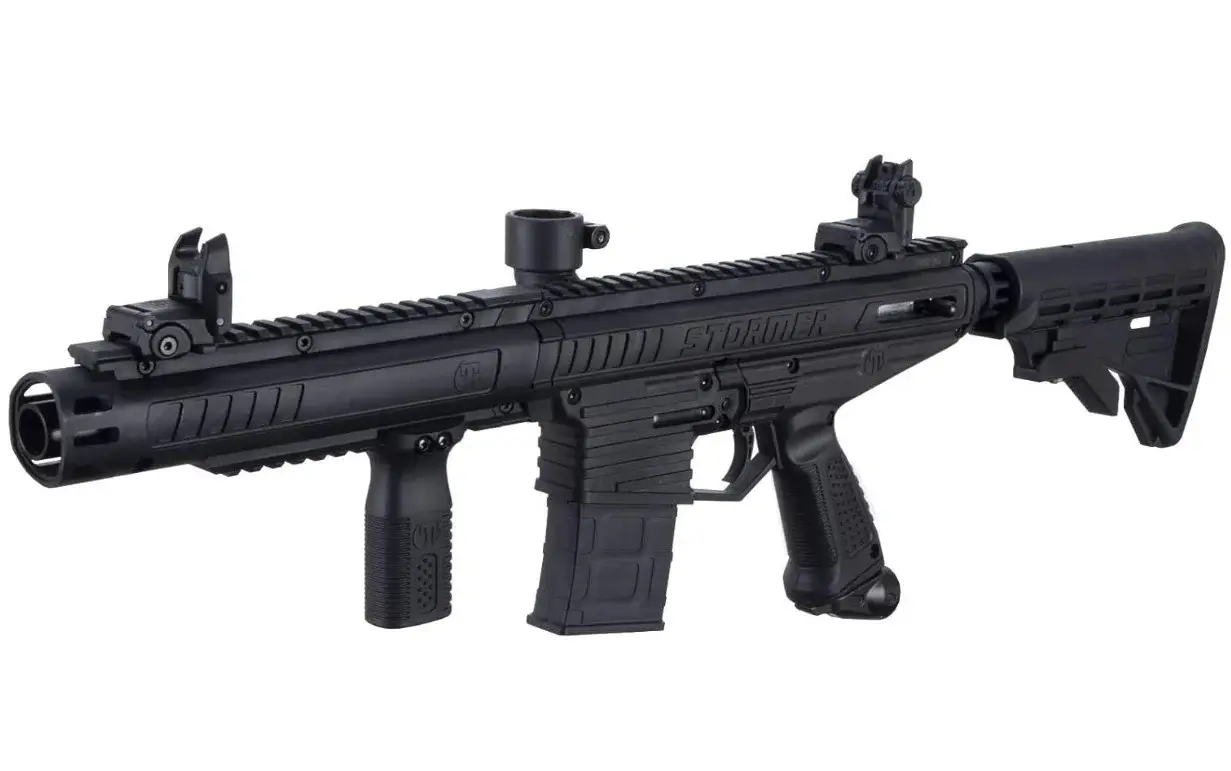
Tippmann Stormer Elite
Feed Configuration: Magazine or hopper Magazine Setup: Two 20-round magazines included First Strike Support: Not officially advertised Main Strength: Accessible dual-feed design
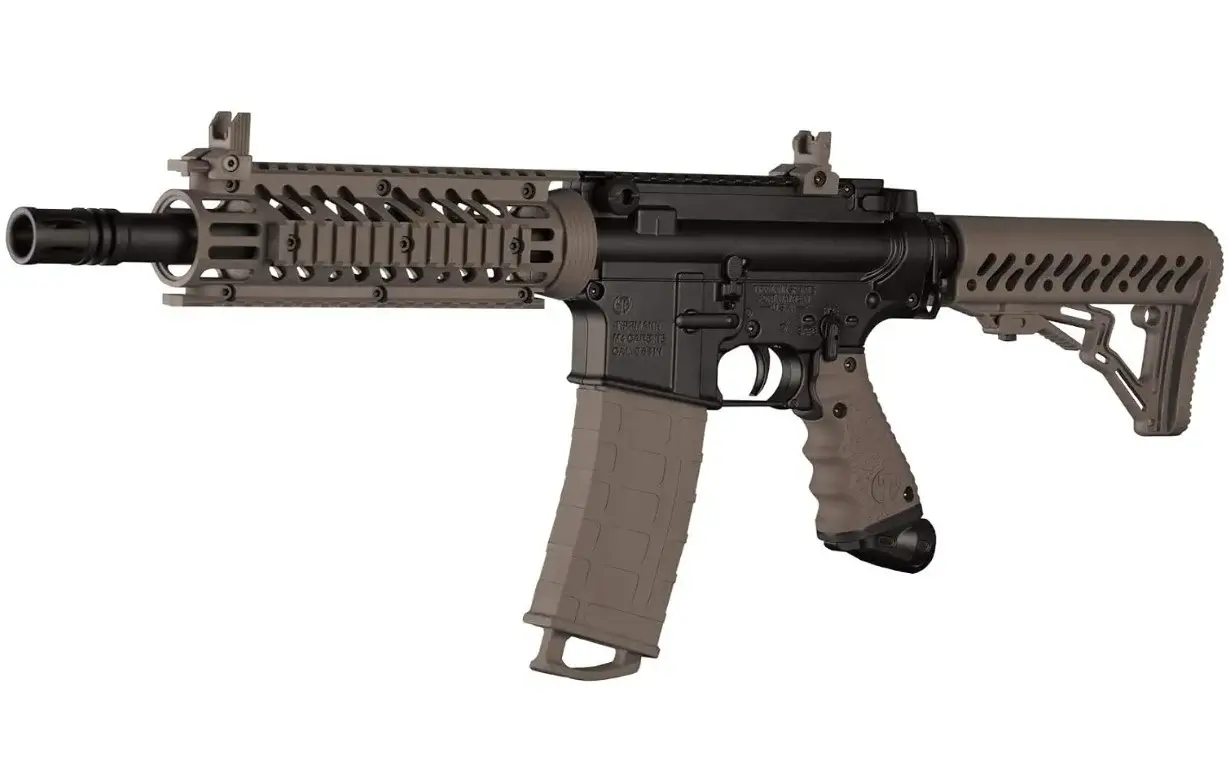
Tippmann TMC Magfed
Feed Configuration: Magazine or hopper Magazine Setup: 20-round TMC magazine system First Strike Support: Not officially advertised Main Strength: Balanced TMC platform
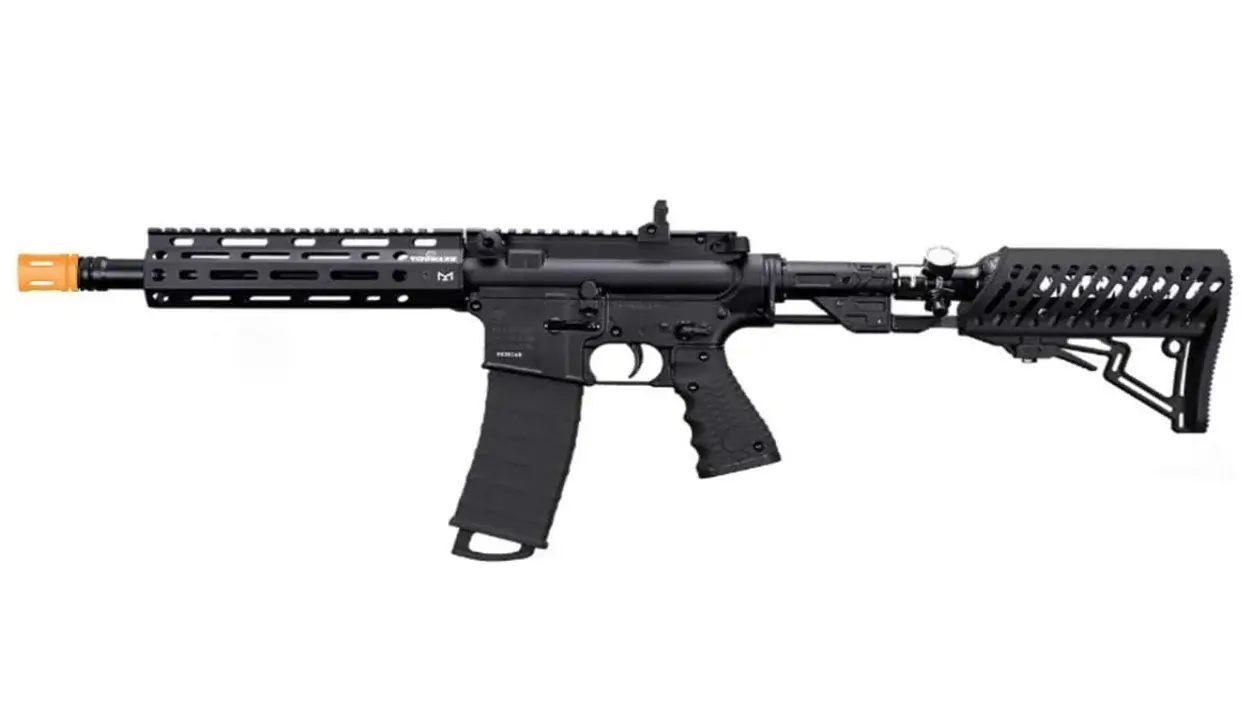
Tippmann TMC Elite
Feed Configuration: Magazine or hopper Magazine Setup: TMC magazine system First Strike Support: Not officially advertised Main Strength: Upgraded TMC configuration
What Matters Most When Choosing a MagFed Marker
A good magazine-fed paintball gun is more than a marker with a magwell attached.
The magazine, feed path, release system, and breech must work together. You also need to consider what happens after those first 20 shots disappear.
Magazine Feeding and Reliability
A detachable magazine has one job: deliver the next paintball correctly.
That sounds simple until dirt, weak feed tension, damaged paint, poor round orientation, or an improperly seated magazine enters the equation.
Pay attention to:
- magazine insertion and retention
- magazine release placement
- follower design
- spring or winding tension
- magazine-to-breech feeding
- resistance inside the feed path
- ease of clearing a misfeed
Reliable feeding becomes especially important when ammunition capacity is limited.
With a hopper, one feeding problem might cost a moment. With a magazine, it can cost a significant part of your remaining load.
That is why I judge magfed paintball markers as complete feeding systems, not simply by their marker bodies.
Magazine Capacity and Reload Practicality
A 20-round magazine sounds straightforward.
Real play makes the number more complicated.
You need to remove the empty magazine, access another one, index it correctly, seat it into the magwell, and continue playing.
Those extra movements make magazine management part of your setup.
A good system should make magazine changes predictable. The release should be reachable, and the magazine should seat without unnecessary wrestling.
You should also think about partial magazines.
Some magazine systems handle removing a partly used magazine better than others. That becomes useful during longer games when you want to reorganize your remaining rounds.
MagFed teaches one lesson quickly: the loudest sound on the field is sometimes an empty magazine saying, “Your planning could have been better.”
Magazine Compatibility
Do not buy a MagFed marker without checking its magazine ecosystem.
Some markers depend on a proprietary magazine. Others can work with more than one compatible system.
Consider:
- available magazine types
- spare magazine availability
- magazine capacity
- magazine construction
- compatible couplers
- cross-platform compatibility
- loading and cleaning access
Compatibility can matter more over time than one small marker feature.
The EMF100 is a good example. Planet Eclipse lists compatibility with its CF20 magazines and DYE DTM-10 and DTM-20 magazines.
That gives buyers more to evaluate than simply counting included magazines.
Dual-Feed Capability
Several markers in this comparison are dual-fed paintball guns.
That means they can operate in a magazine-fed configuration or use a traditional loader setup.
It does not necessarily mean you flick a switch and instantly change feeding systems while shooting.
Changing configurations can involve feed components, blanking parts, or other setup changes.
Tippmann officially describes both the Stormer Elite and TMC as capable of hopper-fed or magazine-fed operation.
This flexibility makes sense for players who enjoy MagFed events but do not want every paintball day limited to magazines.
For a deeper explanation of loaders, see Paintball Renegade’s dedicated paintball hopper and loader guide.
First Strike Compatibility
MagFed and First Strike compatibility are not the same thing.
A marker can accept a detachable magazine without being designed for shaped projectiles.
If First Strike Rounds matter to you, verify support for the marker, magazine, and feed path.
Round orientation becomes especially important with shaped projectiles because they must enter the breech correctly.
Planet Eclipse explicitly lists the EMF100 and CF20 magazine as compatible with First Strike Rounds and standard .68-caliber round ball.
Tippmann does not advertise stock First Strike support on the current Stormer Elite, TMC, or TMC Elite product pages I checked.
That distinction matters before you choose a platform.
1. Tippmann Stormer Elite Dual Fed Marker
Imagine wanting to try magazine-fed paintball without locking yourself into magazines every weekend.
That is where the Stormer Elite makes sense. You can experience limited-capacity reloads, then return to a loader configuration when the game format calls for it.
Magazine and Feed Setup
The Stormer Elite uses a modular dual-feed system.
Tippmann supplies two paintball magazines plus the components needed for loader-to-magazine conversion. The company currently identifies those included magazines as 20-round units.
In real use, that means you can learn the rhythm of magazine insertion, reloads, and limited round management without owning a magazine-only marker.
That flexibility is the Stormer’s strongest argument.
It also reduces the pressure of committing immediately to a large magazine collection.
What Makes the Stormer Elite Different
The Stormer Elite uses a high-impact composite body around Tippmann’s proven in-line bolt platform. It also keeps its gas line internal.
The benefit is straightforward ownership.
The composite construction keeps the platform relatively simple, while the modular feed design gives it more flexibility than the basic Stormer models.
Buyer feedback from the supplied Amazon listing is also positive about durability and overall reliability.
The trade-off is refinement.
The Stormer Elite feels more like an affordable modular platform than a specialized premium MagFed system. Its magazine ecosystem also lacks the sophisticated shaped-round features found in the CF20 platform.
Limitations to Know
First Strike compatibility is the biggest consideration.
Tippmann’s current Stormer Elite specifications promote dual-feed operation but do not list First Strike or shaped-round compatibility.
Buyers specifically planning an FSR-focused setup should therefore look elsewhere or investigate compatible conversions separately.
The composite-heavy build may also feel less substantial to someone comparing it directly with an aluminum-receiver TMC.
That does not make it weak. It simply serves a different buyer.
Who Should Choose It?
The Stormer Elite works best for someone curious about paintball magfed play who still wants hopper flexibility.
It is less suitable for a buyer building around shaped projectiles or a more advanced magazine ecosystem.
Pros
- Dual-feed configuration
- Two magazines included
- Straightforward Tippmann platform
- Easy path into magazine-fed play
Cons
- Stock First Strike support is not advertised
- Less advanced magazine ecosystem than the EMF100
Verdict: Choose the Stormer Elite when flexibility matters more than having the most sophisticated MagFed system.
2. Tippmann TMC 68 Caliber Dual Feed Paintball Marker
Some players try MagFed and immediately realize they want the marker to feel built around that style.
The TMC addresses that buyer better. It retains dual-feed flexibility but delivers it through a more substantial aluminum-receiver platform.
Magazine and Feed System
The TMC is a full pneumatic .68-caliber marker with both hopper and magazine-fed configurations.
Tippmann’s owner documentation identifies a 20-round TMC magazine with its own drive spring, drive cable, ratchet wheel, pawl, and ball-retention components.
That gives the magazine an active role in the feed cycle rather than functioning as a passive storage box.
During play, the biggest change from hopper-fed shooting is mental.
Twenty rounds disappear faster than you expect when adrenaline tells your trigger finger that ammunition is somebody else’s problem.
Regular TMC users frequently praise the platform’s durability and straightforward operation. Feedback supplied with the product data also notes that many buyers appreciate its customization options and weight.
Why Choose the TMC Over the Stormer Elite?
Both are dual-feed Tippmann markers.
The difference is how committed the platform feels to the MagFed experience.
Tippmann equips the TMC with an aluminum receiver, adjustable stock, internal stainless gas line, and dedicated TMC styling.
The Stormer Elite feels like a modular Stormer that can become MagFed.
The TMC feels more like a MagFed-oriented marker that can still use a hopper.
That distinction is subtle on a specification sheet. It is more noticeable when handling the marker and building a regular magazine loadout around it.
Limitations to Know
Do not assume the TMC’s detachable magazine means automatic First Strike support.
Tippmann’s current TMC product information does not advertise FSR or shaped-round compatibility.
That makes the standard TMC more suitable for players planning to use conventional .68-caliber rounds.
Magazine capacity also means you need to plan spare magazines before longer games.
A TMC with one magazine is technically MagFed. It is not a very practical MagFed loadout.
Who Should Choose It?
The standard TMC suits players who expect magazine-fed play to become a regular part of their paintball routine.
Skip it if First Strike compatibility is central to your buying decision.
Pros
- Purposeful MagFed feel
- Dual-feed flexibility
- Durable aluminum receiver
- Established 20-round TMC magazine system
Cons
- First Strike support is not officially listed
- Regular MagFed use requires additional magazines
Verdict: The TMC is the strongest balanced Tippmann choice here for buyers who want MagFed immersion without losing hopper compatibility.
3. Tippmann TMC Elite .68 Caliber MagFed Marker
You may already like the TMC concept but dislike having an external tank hanging from a conventional setup.
That is where the TMC Elite becomes interesting.
It does not reinvent the TMC’s feed system. Instead, it changes how the marker is configured around the player.
What Changes From the Standard TMC?
The major addition is the Air-Thru Stock.
Tippmann also gives the Elite a black anodized lightweight aluminum M-LOK shroud with a Picatinny rail. The underlying platform remains full pneumatic and dual-fed.
That makes the Elite feel cleaner and more integrated around an appropriate air-through-stock setup.
The difference matters most to someone who already knows why they want it.
If you simply want to experience MagFed paintball, the regular TMC already delivers the important magazine-fed functionality.
If you care about the Elite’s stock and front-end configuration, the upgrade becomes easier to justify.
Magazine and Reload Considerations
The TMC Elite remains part of the TMC platform rather than introducing an entirely different magazine architecture.
That is important because there is no reason to relearn the buying decision from zero.
Expect the same broad concerns:
magazine availability, limited round capacity, reload planning, and hopper-versus-magazine configuration.
The advantage comes from the marker setup around that feeding system, not from a revolutionary new magazine.
TMC vs TMC Elite: Which Makes More Sense?
| Choose the TMC | Choose the TMC Elite |
| You mainly want the core MagFed experience | You specifically want the Air-Thru Stock |
| You prefer the standard configuration | You value the upgraded front-end setup |
| Magazine function matters most | Overall configuration matters more |
| You want fewer extras influencing the decision | You already know the Elite features suit your setup |
This is also why buying solely from photos can be misleading.
The Elite certainly looks different, but the real question is whether its configuration improves how you want to carry and use the marker.
Who Should Choose It?
Choose the TMC Elite when you already want a TMC but prefer its more integrated configuration.
Do not choose it merely because “Elite” sounds better.
If the standard TMC already solves your magazine-fed needs, additional hardware does not automatically make the playing experience better.
Pros
- Same dual-feed flexibility as the TMC concept
- Air-Thru Stock
- Aluminum M-LOK shroud
- Cleaner integrated configuration
Cons
- Core magazine experience remains closely related to the standard TMC
- FSR support is not listed by Tippmann
Verdict: The TMC Elite makes sense for a specific configuration preference, not simply as an automatic upgrade over the TMC.
4. Action Village Planet Eclipse EMEK EMF100 MagFed Package
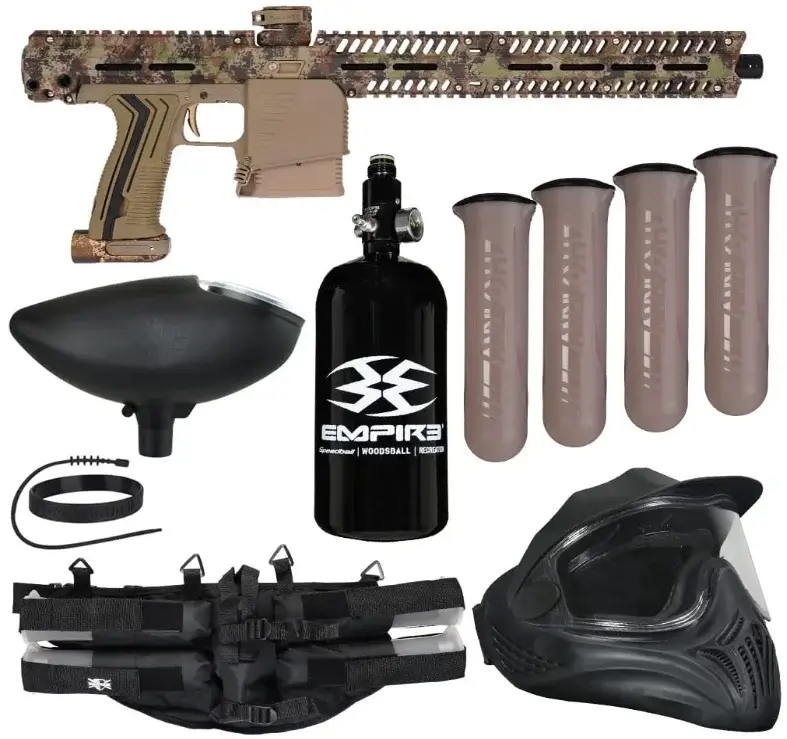
Now consider the player who already knows MagFed is not a weekend experiment.
They care about how rounds stack, how magazines feed, what happens when a magazine is partly empty, and whether shaped projectiles work without fighting the system.
That is the EMF100’s territory.
EMF100 Magazine Feeding System
Planet Eclipse built the EMF100 around both magazine-fed and loader-fed configurations.
Its official specifications list CF20 and DYE DTM magazine compatibility plus support for First Strike and regular round-ball projectiles.
The feed architecture receives unusually serious attention.
Planet Eclipse says it developed the magazine, magwell, and breech geometry around both round ball and shaped rounds. It also uses a Gamma Core drivetrain with a staged loading action.
That matters because feeding reliability is not simply about having a powerful magazine spring.
Rounds must leave the magazine, enter the breech in the right position, and avoid getting damaged during the process.
Planet Eclipse describes MagFed as a format where “every shot counts.” Its engineering choices make sense in that context.
CF20 Magazine Ecosystem
The CF20 is where the EMF100 becomes much more interesting from an NLP perspective and, more importantly, from a buyer’s perspective.
It is a continuous-feed magazine designed for standard .68-caliber round ball and shaped rounds.
Planet Eclipse lists capacity at 21 round balls or 20 shaped projectiles.
Its removable side panel lets you see and load rounds directly.
That becomes particularly useful with First Strike ammunition because correct round stacking matters.
The magazine also uses:
- a pawl-and-ratchet winding mechanism
- integrated capacity indicators
- a shaped follower
- a roller shutter door
- sealed construction
- removable side access
- compatible magazine couplers
Planet Eclipse says the follower blocks the breech after the magazine empties, helping prevent dry firing.
The winding mechanism also allows a partly used magazine to be removed with less round wastage.
That is a small detail until you actually manage several partial magazines during a game.
The newer CF20 Pro develops the concept further with a polished aluminum feed trough and ball bearings in the winding assembly. It remains compatible with the EMF100.
Shaped-Round Compatibility
This is the clearest separation between the EMF100 and the three Tippmann markers reviewed above.
Planet Eclipse officially supports First Strike shaped rounds.
The CF20 side panel helps users verify projectile orientation before closing the magazine. Its internal feed design aims to reduce flipped shaped rounds and jams.
That does not mean you should expect magic.
Paint quality, cleanliness, magazine condition, correct loading, and field conditions still matter.
However, the platform was designed with shaped-round feeding as an intended function rather than an afterthought.
If you want to understand the projectile itself, read Paintball Renegade’s separate guide covering what First Strike paintballs are.
Loader-Fed Configuration
The EMF100 is not trapped in magazine mode.
Planet Eclipse provides a PAL-compatible feed system and describes the marker as supporting both MagFed and loader-fed configurations.
That gives the EMF100 an advantage similar to the Tippmann dual-feed options.
The important difference is the depth of its magazine ecosystem.
You are not choosing between versatility and a sophisticated magazine system. You can have both.
Who Should Choose It?
The EMF100 suits players who already understand why they want magazines.
It makes the strongest case for buyers who prioritize shaped-round compatibility, feed engineering, CF20 magazines, partial-mag handling, or broader magazine compatibility.
It may be unnecessary for someone who only wants to experiment with MagFed occasionally.
Pros
- First Strike and round-ball compatibility
- CF20 and DYE DTM magazine support
- Continuous-feed magazine system
- Strong partial-magazine handling
- Loader-fed option
Cons
- More capability than casual MagFed users may need
- Magazine features reward buyers willing to learn the system
Verdict: Among these four best magazine-fed paintball guns, the EMF100 offers the most developed magazine and shaped-round ecosystem.
Stormer Elite vs TMC vs TMC Elite vs EMF100
Once the feature lists disappear, the decision becomes much easier.
Each marker solves a different version of the same MagFed problem.
| Your Main Priority | Best Match |
| Easy entry into dual-feed MagFed | Tippmann Stormer Elite |
| Balanced Tippmann MagFed platform | Tippmann TMC |
| Air-through-stock TMC configuration | Tippmann TMC Elite |
| First Strike compatibility | Planet Eclipse EMF100 |
| Advanced magazine design | Planet Eclipse EMF100 |
| CF20 magazine ecosystem | Planet Eclipse EMF100 |
| Hopper and magazine flexibility | All four, with setup differences |
The Stormer Elite makes the easiest case for someone testing the format.
The TMC feels more committed to regular MagFed use without abandoning hopper flexibility.
The TMC Elite is more specialized. Buy it when its configuration matters to you, not simply because it sits above the regular TMC.
The EMF100 wins when the magazine itself becomes part of your buying criteria.
That includes First Strike compatibility, round orientation, continuous feeding, capacity indicators, and cross-compatible magazines.
Check the Magazine Ecosystem Before You Buy
A marker purchase gets the attention.
Magazines determine whether the setup remains enjoyable six months later.
Before choosing any magfed paintball marker, look beyond the marker body and check how easy its feeding ecosystem will be to live with.
Included Magazines
Start with what arrives with the marker.
The Stormer Elite currently includes two 20-round magazines.
The current EMF100 configuration listed by Planet Eclipse includes a CF20 magazine, although package contents can vary between retailers.
TMC packages can also vary by seller.
Always check the exact listing before ordering.
You do not want to discover on game day that the photograph showed equipment the box never promised.
Spare Magazine Availability
The number of compatible magazines matters more than many first-time MagFed buyers expect.
Think about whether:
- replacement magazines are easy to find
- multiple compatible magazine types exist
- damaged parts can be serviced
- magazines are easy to load
- the system supports partial reloads well
The TMC uses its dedicated TMC magazine family.
The EMF100 has the broader system in this comparison because Planet Eclipse lists CF20, CF20 Pro, and DYE DTM compatibility.
There is no universal winner here.
A simple proprietary magazine can be perfectly fine when it is dependable and readily available.
Reload Loadout
Your real magazine capacity is not what one magazine holds.
It is what your complete usable loadout holds.
A 20-round magazine system changes the way you plan compared with carrying a loader full of paint.
You need to think about:
- how many magazines you can comfortably carry
- how often you expect to reload
- whether partial magazines are easy to manage
- how quickly you can identify loaded and empty magazines
Do this calculation before committing to a platform.
MagFed becomes much less enjoyable when half your attention goes toward wondering which magazine still has paint in it.
MagFed Buying Mistakes to Avoid
The wrong purchase usually comes from one incorrect assumption.
Avoid these mistakes, and choosing between magazine-fed paintball guns becomes much easier.
Assuming Every MagFed Marker Supports First Strike Rounds
A magazine does not automatically equal shaped-projectile compatibility.
The EMF100 officially supports First Strike rounds. Tippmann’s current Stormer Elite and TMC product pages do not make the same claim.
Verify compatibility before building your setup around FSR ammunition.
Assuming Dual Feed Means Instant Switching
Dual-feed means the marker supports two feed configurations.
You may still need to install or remove components when changing between hopper and magazine use.
Think of it as two available setups, not necessarily two simultaneously active feeding systems.
Looking Only at Magazine Capacity
One magazine holding an extra round means little if loading it is frustrating.
Consider the complete experience.
Feed tension, magazine insertion, spare-mag availability, partial-mag handling, and cleaning access all affect ownership.
The best magazine is not always the one with the biggest number printed beside it.
Ignoring the Magazine Ecosystem
You are not simply choosing a marker.
You are choosing the magazines you may continue using for years.
Check availability and compatibility before becoming committed to a proprietary system.
This is one reason the CF20 and DYE DTM compatibility of the EMF100 deserves attention.
Treating the TMC and TMC Elite as the Same Purchase
Their core MagFed concept is closely related.
Their configurations are not identical.
The Elite adds the Air-Thru Stock and aluminum M-LOK front-end treatment.
If those differences solve a problem for you, choose the Elite.
If they do not, the standard TMC remains the more straightforward option.
Which MagFed Paintball Gun Should You Choose?
There is no universal best magfed paintball gun because the four markers serve different buyers.
- Choose the Tippmann Stormer Elite if you want an accessible way to experience magazine-fed play while keeping hopper flexibility.
- Choose the Tippmann TMC if you expect MagFed to become a regular part of your playing style and want a more purpose-built Tippmann platform.
- Choose the TMC Elite when you specifically want the TMC experience with its Air-Thru Stock and upgraded configuration.
- Choose the Planet Eclipse EMF100 if your priorities include First Strike compatibility, CF20 magazines, feed-system engineering, and a broader magazine ecosystem.
For most buyers, that is the decision that matters.
Do not buy the marker with the longest feature list. Buy the magazine-fed system whose limitations you are comfortable living with.
That is especially true in MagFed, where every reload reminds you exactly which system you chose.
Whatever marker you take onto the field, follow the manufacturer’s instructions, use approved paintball eye and face protection, and comply with your field’s safety rules.