
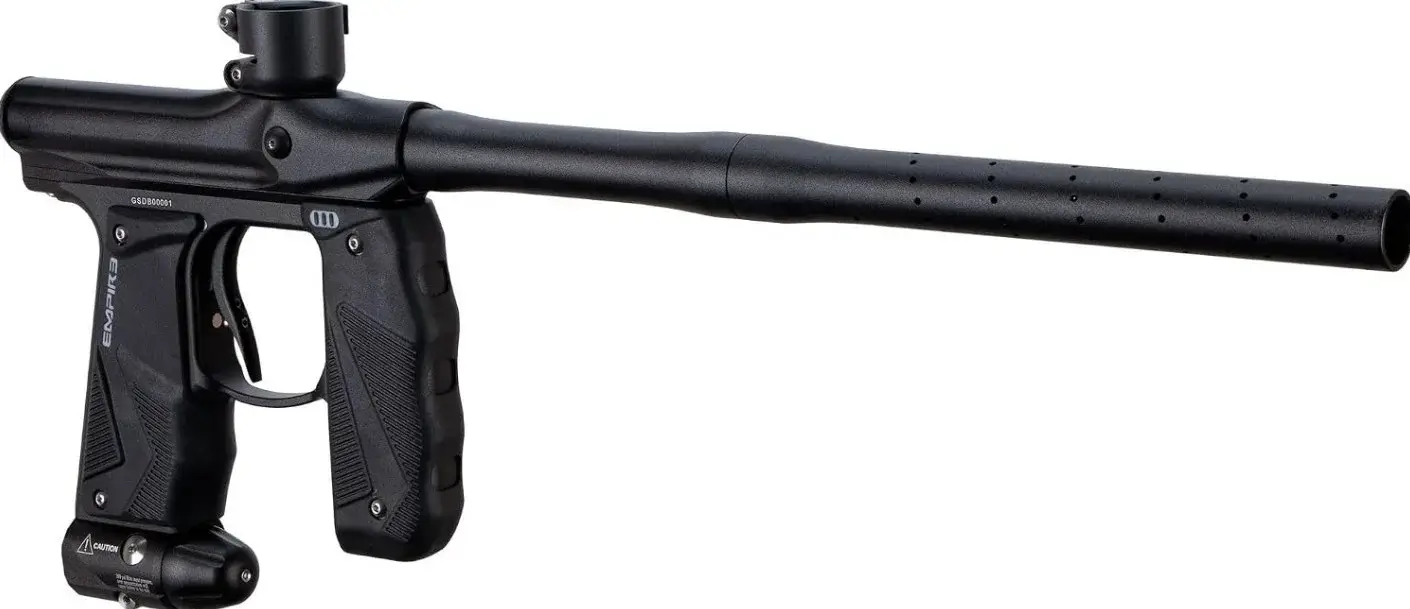
Empire Mini GS
Best For: Best overall balance
Firing System: Electronic poppet
Electronic Eyes: Break-beam
Main Modes: Semi, ramping, programmable modes
Battery: Electronic
Skill Level: Beginner to intermediate
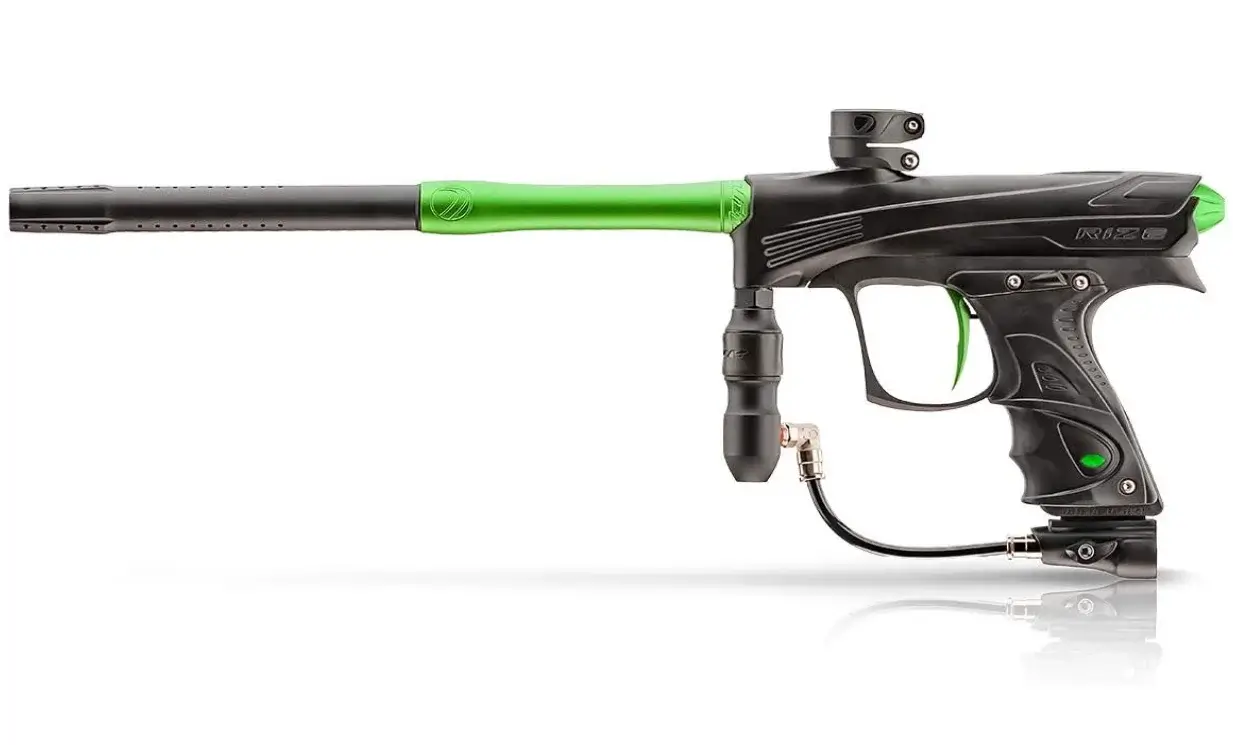
Dye Rize CZR
Best For: Best value performance
Firing System: Electro-pneumatic
Electronic Eyes: Internal anti-chop eyes
Main Modes: Programmable electronic modes
Battery: 9V
Skill Level: Beginner to intermediate
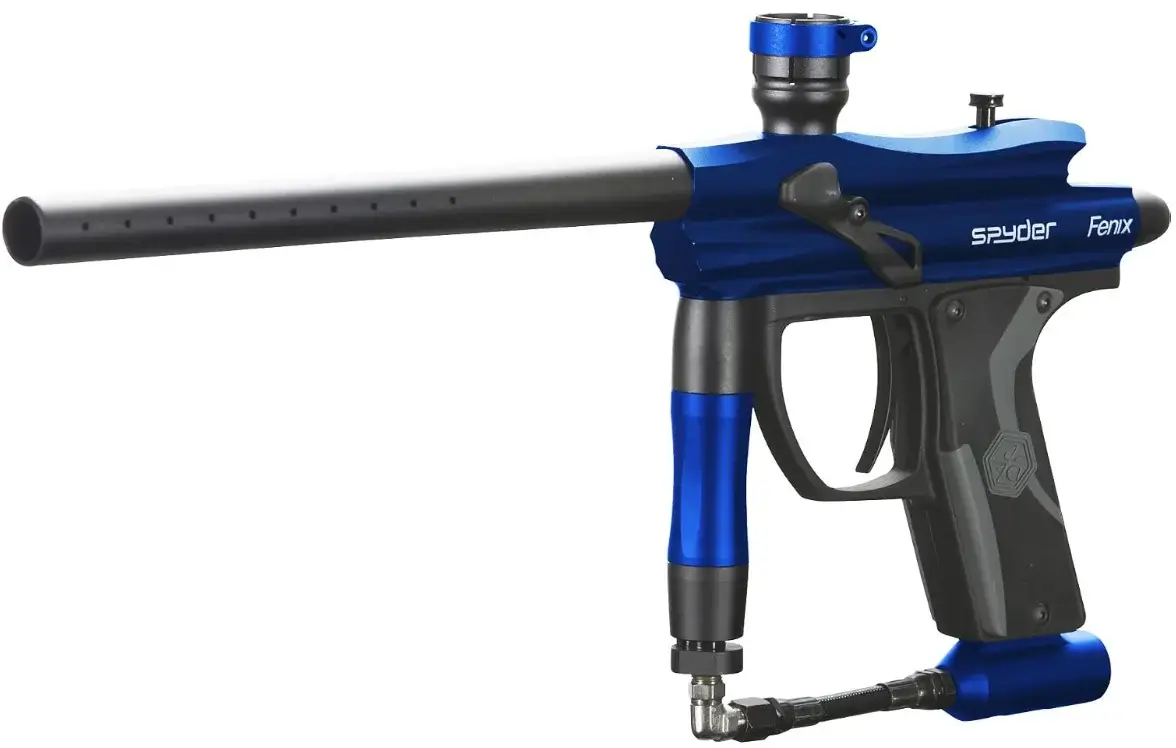
Spyder Fenix
Best For: Best budget-friendly programmable option
Firing System: Electronic valve system
Electronic Eyes: Break-beam
Main Modes: Semi, Ramp PSP, Ramp Millennium
Battery: 9V
Skill Level: Beginner to intermediate
A quick warning belongs here.
The Empire Mini GS should use compressed air or nitrogen, not CO2. Some retail database fields list CO2 incorrectly. Empire’s Mini GS manual explicitly warns that CO2 can damage the marker.
That is a useful reminder for any electronic marker purchase. Manufacturer manuals beat marketplace specification tables when the two disagree.
What Is an Electronic Paintball Gun?
An electric paintball gun is usually called an electronic paintball marker by experienced players and manufacturers.
The battery does not normally launch the paintball itself. Instead, electronics control when and how the pneumatic system fires.
That distinction matters because a battery-powered trigger system can offer much finer firing control than a simple mechanical trigger.
How an Electronic Paintball Marker Works
The basic firing chain looks like this:
trigger sensor → control board → solenoid → pneumatic firing cycle
When the player pulls the electronic trigger, a microswitch or sensor sends a signal.
The marker’s control board processes that input. It then activates the solenoid valve, which controls airflow through the firing system.
Depending on the marker, the bolt may use a spool, poppet, or related pneumatic design.
That is why many high-performance electronic markers are more precisely described as electro-pneumatic paintball markers.
The electronics manage timing. Compressed gas provides the working force.
In practical terms, the player notices a lighter trigger, faster response, and more programmable behavior.
Electronic Eyes and Anti-Chop Systems
Speed is useless if the loader and marker cannot agree on where the next paintball is.
Electronic eyes help solve that problem.
A break-beam eye system normally checks whether a paintball is properly positioned in the breech before allowing the firing cycle.
This reduces the chance of the bolt cycling into a partially fed ball.
That becomes more important as the rate of fire increases.
DYE’s current 4th Generation Eye Pipe, used on compatible DYE markers including the DSR+ and CZR, also protects the anti-chop eye system from dirt and broken paint.
Eyes are not glamorous.
Nobody shows up at the staging area bragging, “Check out my infrared sensor.”
Yet reliable eyes can matter more during a fast string than another cosmetic upgrade.
4 Best Electric Paintball Guns Reviewed
Specifications only tell part of the story.
What matters is how each electric paintball gun fits a real player, especially after the first exciting weekend has passed.
1. Empire Mini GS: Best Overall Electric Paintball Gun
Picture a recreational player moving from rental equipment into personal gear.
They want electronic performance, but they do not want a marker that feels like a laptop with a barrel attached.
That situation suits the Empire Mini GS.
Its compact frame and pressure-controlled poppet engine make it an approachable step into electronic paintball.
The marker uses integrated break-beam anti-chop eyes. Its board supports multiple firing modes and electronic adjustments.
The Mini GS manual lists semi-auto, PSP, and Millennium ramping, plus an NXL full-auto setting on the referenced board generation. It also includes a tournament lock.
Real-World Performance
The first thing many players notice is the size.
The Mini GS feels short and compact in the hands. That can make movement around bunkers feel natural.
The electronic trigger also requires less physical effort than a traditional mechanical firing system.
Its eyes help manage paint feeding when the shooting pace increases.
Customer feedback supplied with the listing is generally positive about performance and programming. Some buyers describe it as easy to use immediately.
There are also reported air-leak and durability complaints.
Those reports do not make every Mini GS unreliable, but they belong in the buying decision.
Who It Is Best For
The Mini GS makes sense for:
- newer players entering electronic paintball
- recreational speedball players
- players who prefer compact markers
- buyers wanting adjustable firing modes without premium complexity
Who Should Skip It
Look elsewhere if:
- you want a larger grip and body
- you dislike compact marker ergonomics
- you want a modern display-based interface from the factory
- you specifically need a marker designed around CO2
The last point matters.
Despite a marketplace specification saying otherwise, Empire documentation says the Mini GS is designed for compressed air or nitrogen only.
Trade-Off
The Mini GS packs plenty into a small frame, but compactness is personal.
Large-handed players may prefer something roomier.
Advanced players may also want easier screen-based programming without adding an optional board.
Verdict: The Empire Mini GS is the strongest all-around choice here for players entering electronic markers without immediately jumping into premium tournament hardware.
2. Dye Rize CZR: Best Value Electronic Paintball Marker
A different player wants tournament-style electronic behavior but still values straightforward ownership.
That is where the Dye Rize CZR becomes interesting.
DYE built the CZR around features commonly associated with more advanced electronic markers.
These include a Hyper3 regulator, RAMP solenoid, internal anti-chop eyes, and 4th Generation Eye Pipe.
Real-World Performance
The CZR’s biggest advantage is not one flashy specification.
It is how several useful systems work together.
The electronic firing system gives a light, responsive trigger feel.
The regulator manages operating pressure, while the solenoid controls the pneumatic cycle.
The Eye Pipe helps protect the anti-chop system from paint and debris.
Maintenance is also less intimidating than the internal parts list might suggest.
DYE specifically designed the Eye Pipe and color-coded O-rings to simplify service. Replacement components remain documented through DYE’s current parts catalog.
Imagine a player practicing every second weekend.
They want enough performance for speedball, but they do not enjoy spending Saturday night diagnosing electronics.
That is the CZR’s sweet spot.
Who It Is Best For
Consider the CZR if you want:
- an electro-pneumatic marker
- tournament-style electronic behavior
- internal anti-chop eyes
- a 9V-powered system
- relatively simple access to maintenance parts
- a bridge between entry-level and premium equipment
Who Should Skip It
The CZR may not be the right fit if:
- you want a premium OLED interface
- you prefer the smallest possible marker
- you want the newest flagship platform
- you strongly dislike maintaining pneumatic electronics
Trade-Off
Customer feedback is mixed.
Some owners report solid reliability, while others describe defective units or early operating problems.
That makes proper inspection, setup, and maintenance important.
The upside is that DYE still provides manuals and CZR-compatible parts information.
Verdict: The Rize CZR suits players who want real electronic performance without climbing directly into premium tournament-marker territory.
3. Spyder Fenix: Best Budget-Friendly Electronic Paintball Gun
Some players do not need an OLED screen, endless tuning pages, or a marker that looks ready for a professional pit crew.
They want programmable modes and electronic firing without making the system unnecessarily complicated.
The Spyder Fenix fits that mindset.
It uses an EKO Valve system, electronic board, magnetic-response trigger, and break-beam anti-chop eyes.
Its listed modes include Semi-Auto, Ramp PSP, and Ramp Millennium.
The supplied specifications also list a claimed firing capability of 25 BPS.
That number needs context.
A marker’s technical ceiling is not the same as a legal field setting.
Real-World Performance
The Fenix gives players more electronic interaction than a simple mechanical marker.
The LEAP II circuit board handles firing modes, while the electronic trigger responds with less physical movement.
Its 9V alkaline battery is listed for roughly 2,000 to 2,500 shots under the provided specifications.
The marker is also listed as compatible with both CO2 and compressed air.
That flexibility separates it from many electro-pneumatic tournament markers.
A useful micro use-case would be a casual player switching between woodsball and occasional speedball sessions.
They want ramping available when appropriate, but they are not building a tournament-only setup.
The Fenix can fit that role.
Who It Is Best For
The Spyder Fenix makes sense for:
- players exploring electronic firing modes
- recreational players
- buyers comfortable with an older electronic platform
- players wanting CO2 or compressed-air compatibility
- users who value simple 9V battery replacement
Who Should Skip It
It is less attractive if:
- you want modern tournament ergonomics
- you want current flagship electronics
- you need extensive manufacturer ecosystem support
- you prefer a premium spool-style shot feel
Trade-Off
Age is the biggest consideration.
Older electronic platforms can still work well, but replacement parts and support deserve more attention.
The supplied customer feedback also includes an air-leak complaint.
That should encourage careful inspection rather than automatic rejection.
Verdict: The Spyder Fenix works best for players who want programmable electronic firing without needing a current premium tournament platform.
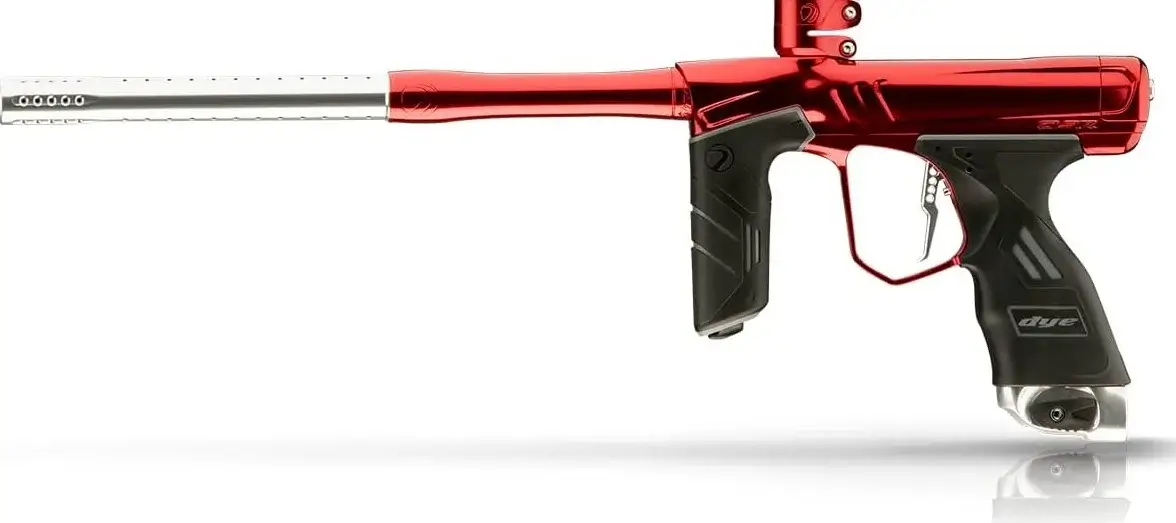
4. DYE DSR+: Best Premium Tournament Electronic Marker
Now picture a player who already understands electronic markers.
They care about trigger feel, shot consistency, tuning, quick maintenance, and tournament usability.
That player is much closer to the DYE DSR+ audience.
The DSR+ combines DYE’s ARC+ Bolt System, Flex SFR solenoid, Edge2 trigger, MOS operating system, and 4th Generation Eye Pipe.
DYE also supports tool-less battery access and quick bolt maintenance on this platform.
Real-World Performance
The DSR+ feels less like an introduction to electronic paintball and more like a refined system.
The Flex SFR solenoid allows tuning of the marker’s pneumatic behavior.
The Edge2 trigger gives the player direct control over the electronic firing input.
The MOS interface makes settings easier to navigate than basic LED-only programming.
That matters during actual ownership.
Changing a setting through a readable menu is less frustrating than memorizing a sequence of blinking lights.
The ARC+ bolt system also focuses on consistent cycling and paint handling.
DYE still lists the DSR+ within its current product and support ecosystem.
Who It Is Best For
The DSR+ suits:
- experienced electronic-marker users
- tournament players
- serious speedball players
- buyers who value display-based programming
- players who want deeper electronic and pneumatic tuning
Who Should Skip It
It is probably unnecessary if:
- you play casually a few times each year
- you want the simplest possible controls
- you dislike electronic tuning
- you only need basic semi-auto recreational play
Trade-Off
More adjustability means more settings to understand.
A beginner can certainly use the DSR+, but they may pay attention to features they do not yet need.
The supplied customer feedback is very limited compared with the Mini GS and CZR.
That makes broad reliability conclusions harder to justify from marketplace reviews alone.
Verdict: The DYE DSR+ is the strongest choice here for players who already know why advanced electronics, tuning, and tournament ergonomics matter.
How to Choose the Best Electronic Paintball Gun
Buying an electronic paintball marker gets easier once marketing language is stripped away.
I would focus on six things.
The marker should suit how you actually play, not the player you imagine becoming next Saturday.
Trigger and Firing Response
An electronic trigger does not mechanically release the firing system like a traditional sear.
Instead, a microswitch, magnetic sensor, or similar trigger sensor sends an electronic signal.
That allows:
- shorter trigger travel
- lighter activation
- adjustable sensitivity
- faster reset
- more consistent input
The practical result is simple.
You can fire quickly without pulling through a heavy mechanical action each time.
That matters most during rapid snap shooting or sustained tournament play.
It matters much less to someone casually shooting a few rounds every month.
Firing Modes and Rate of Fire
Don’t choose an electronic marker simply because its board offers more firing modes.
For most players, the useful question is whether the marker gives you the firing behavior you need while staying within the rules of the field or event.
Semi-auto is the baseline. Ramping adds electronic assistance once its programmed trigger conditions are met, while burst and full-auto modes may be available on some boards but are often restricted or prohibited in organized play.
Rate of fire is measured in balls per second (BPS), but the highest number on a specification sheet should not decide the purchase. Your loader, paint quality, air system, field rules, and actual firing mode all affect what the marker can usefully deliver.
For recreational play, reliable feeding and a predictable trigger are usually more valuable than an extreme theoretical BPS figure.
Battery and Electronic Controls
No battery means no functioning electronic firing system.
That is the small tax you pay for electronic convenience.
Common marker power systems include:
- 9V alkaline batteries
- rechargeable marker batteries
- lithium-based systems on some platforms
Also consider how easy the battery compartment is to access.
A quick battery change between games is much better than dismantling half the grip frame.
Board interfaces matter too.
Basic LED systems can work perfectly well, but they require memorizing light patterns.
OLED or menu-based systems make programming clearer.
Advanced settings may include dwell, debounce, trigger sensitivity, and rate-of-fire limits.
Do not adjust dwell simply because the option exists.
Incorrect dwell can affect cycling and efficiency.
Factory settings are usually the sensible starting point.
Spool vs Poppet Operation
Electronic markers can use different pneumatic architectures.
Two common terms are spool valve and poppet valve.
Poppet-based designs often have a more distinct firing impulse and can be efficient.
Spool-style systems are often associated with a smoother shot feel.
That is only a broad tendency.
Modern marker design blurs simple category stereotypes.
Instead of choosing from internet mythology, look at:
- shot feel
- efficiency
- maintenance access
- operating pressure
- replacement parts
- manufacturer support
The best engine is the one you can maintain confidently.
Hopper and Air-System Compatibility
A fast marker still needs paintballs delivered into the breech.
A basic gravity hopper may struggle during sustained electronic firing.
An electronic loader can feed more consistently and reduce gaps in the ball stack.
When choosing the best electric hopper for paintball, do not chase the highest theoretical feed speed.
Match the hopper to the marker’s actual field-legal firing rate.
Reliability matters more than an absurd number printed on a box.
Air compatibility also needs careful checking.
Many performance electronic markers use compressed air or HPA.
Some older electronic designs can also use CO2.
Never assume compatibility from the phrase “electronic paintball gun.”
The Mini GS is a perfect example. Its manual specifically says compressed air or nitrogen only.
Maintenance and Parts Support
Electronic markers add components that mechanical markers do not have.
Those may include:
- electronic eyes
- circuit boards
- trigger sensors
- solenoids
- battery connectors
- wiring
- firmware controls
That does not automatically make them difficult to own.
Good design matters more than component count.
Check whether you can easily access:
- bolt assembly
- eye system
- battery
- O-rings
- regulator service parts
- solenoid
- replacement electronics
DYE, for example, currently maintains manuals and replacement-part catalogs for several of its electronic platforms.
Parts support can matter more after three seasons than another firing mode does on day one.
Electronic vs Mechanical Paintball Guns
The choice between electronic and mechanical is less about which marker is “better” and more about what you want to deal with between games.
Factor | Electronic Marker | Mechanical Marker |
Trigger | Electronic sensor or switch | Mechanical action |
Battery | Required | Usually not required |
Firing modes | Often programmable | Usually basic semi-auto |
Rate of fire | Higher potential | Limited by mechanical trigger operation |
Adjustability | High | Usually lower |
Troubleshooting | Electronics plus pneumatics | Mechanically simpler |
Best fit | Speedball and competitive play | Simple recreational use |
Choose electronic when fast trigger response, programmable firing, and electronic eyes are genuinely useful to you.
Choose mechanical when you would rather eliminate batteries, boards, sensors, and additional electronic components from the equation.
Neither system automatically makes a marker more accurate. Paint quality, velocity consistency, barrel condition, air supply, and player technique still have a much larger influence on where the ball actually goes.
The real trade-off is simple: electronic markers buy you control and speed at the cost of added complexity.
Ramping, Full-Auto, and Other Electronic Firing Modes
Electronic boards create firing behaviors that mechanical triggers cannot easily reproduce.
This is also where terms such as automatic paintball gun, fully automatic paintball marker, and paintball machine gun start creating confusion.
They do not all mean the same thing.
What Is Ramping in Paintball?
Paintball ramping begins with physical trigger pulls.
Once programmed conditions are met, the board can increase or maintain the firing rate according to its ramping logic.
Typical ramping concepts include:
- activation threshold
- trigger pulls per second
- sustained trigger input
- ramping BPS
- BPS cap
- tournament mode
- tournament lock
In simple terms, the player keeps working the trigger.
The board then assists the firing rate once its programmed conditions are satisfied.
That is why ramping paintball feels different from ordinary semi-auto.
League-specific programming can vary.
Current NXL rulebooks should be checked before tournament play rather than relying on an old board preset labeled “NXL.”
Ramping vs Full-Auto
Ramping is not the same as full-auto.
With ramping, the board follows programmed trigger-input conditions.
A full-auto mode uses different logic that allows continued firing under its programmed activation condition.
An electronic marker may offer:
- semi-auto only
- semi-auto and ramping
- multiple ramping profiles
- burst
- full-auto
- several selectable modes
So an electronic paintball gun is not automatically a fully automatic paintball gun.
Likewise, “paintball machine gun” is mainly a consumer search phrase.
It is not a precise technical marker category.
Before using any ramping, burst, or automatic mode, check the rules of the field or event.
A mode existing on the board does not mean the referee wants to see it.
Can You Get a Good Electric Paintball Gun Under $200?
The search for an electric paintball gun under $200 often leads buyers toward older platforms, used equipment, discontinued markers, or basic electronic designs.
That does not automatically make them poor choices.
It does change what should be inspected.
When considering a cheap electric paintball gun, check:
- whether replacement boards still exist
- solenoid availability
- eye-system condition
- battery connector condition
- regulator condition
- O-ring availability
- manufacturer documentation
- loader compatibility
A cheap marker with a dead proprietary board can become an expensive paperweight.
That is the hidden trap.
Also consider the full setup.
An electronic marker may need a loader capable of feeding at its intended rate.
It may require compressed air.
Batteries and maintenance parts also become part of ownership.
The cheapest electric paintball gun is therefore not always the cheapest system to keep playing.
For a starter, I would rather choose a simpler marker with available parts than a forgotten flagship with impossible-to-find electronics.
Electric Paintball Gun Maintenance and Troubleshooting
Electronic markers reward simple preventive maintenance.
They also punish random screwdriver enthusiasm.
Before diagnosing something dramatic, check the basics:
- fresh battery
- proper air supply
- clean eyes
- correct board mode
- clean bolt system
- healthy O-rings
- factory-recommended settings
That short list solves more problems than frantic menu programming.
Electronic Marker Turns On but Won’t Fire
Use this order:
air → battery → eyes → firing settings → trigger sensor → solenoid
First, confirm the marker is properly aired according to its manual.
Then check battery condition.
A battery may still power an LED while lacking enough voltage for reliable solenoid operation.
Next, inspect the eyes.
If the board thinks no ball is present, it may intentionally prevent normal firing.
After that, verify the firing mode and trigger input.
Only then should the trigger sensor or solenoid become the main suspects.
This order avoids replacing expensive components before checking simple causes.
Electronic Eyes Not Working
Dirty paintball eyes are common.
Broken paint, shell fragments, grease, or debris can interfere with the beam.
Symptoms can include:
- refusal to fire normally
- unusual firing behavior
- eye fault indication
- reduced firing rate
- operation only with eyes bypassed
Clean the breech and eye system according to the manufacturer’s manual.
Do not attack delicate sensors with sharp tools.
DYE’s Eye Pipe design specifically helps shield its anti-chop system from dirt and broken paint.
Board or Solenoid Problems
A real electronic fault can look different from a dirty eye.
Common signs include:
- solenoid not clicking
- inconsistent cycling
- repeated programming errors
- trigger input not registering
- unexplained shutdown
- settings returning incorrectly
- dwell-related cycling problems
If the marker suddenly behaves badly after changing dwell, debounce, or other board settings, restore recommended settings first.
Do not keep increasing dwell hoping the marker becomes “more powerful.”
That is not how the system works.
Solenoid maintenance also varies by model.
Use the correct manual before disassembly.
DYE maintains marker manuals for the DSR+ and Rize CZR, which should be the first reference for model-specific service.
FAQs
How Long Does an Electronic Paintball Gun Battery Last?
Battery life varies widely.
It depends on the battery chemistry, marker board, solenoid, settings, firing frequency, and battery condition.
Some markers use standard 9V batteries. Others use rechargeable power systems.
The Spyder Fenix specifications supplied for this guide claim roughly 2,000 to 2,500 shots from a 9V alkaline battery.
Treat manufacturer estimates as planning figures, not guarantees.
Carry a fresh spare when the marker uses replaceable batteries.
Can You Use an Electric Paintball Gun in the Rain?
Electronic does not automatically mean waterproof.
Some markers handle normal field moisture better than others, but water can still enter grips, battery compartments, connectors, eyes, or boards.
Keep grip panels secure.
Avoid submerging the marker.
Dry exterior moisture after play and follow the manufacturer’s cleaning instructions.
If heavy rain is expected, check the individual marker manual before assuming it is safe.
Do Electric Paintball Guns Shoot Farther Than Mechanical Guns?
Not simply because they are electronic.
Electronics mainly affect:
- trigger response
- firing timing
- firing modes
- rate-of-fire control
- programmability
They do not magically extend effective range.
A properly operating mechanical marker can send the same caliber paintball at the same field-legal velocity.
Electronic control can improve consistency and firing behavior, but battery power itself does not make the paintball fly farther.
Final Takeaway
The best electric paintball gun is not the marker with the longest feature list.
It is the one whose electronics solve problems you actually have.
For a newer player, that may mean reliable eyes, simple programming, and easy maintenance.
For a tournament player, trigger response, solenoid behavior, board controls, and tuning become more important.
The Empire Mini GS offers the strongest overall balance here. The Rize CZR adds useful electro-pneumatic value, while the Spyder Fenix keeps programmable electronic play accessible.
The DYE DSR+ belongs at the advanced end of the group.
Whichever route you take, learn the board before changing advanced settings, use the correct air source, keep the eyes clean, and check current field rules before turning on aggressive firing modes.
A well-set electronic marker should feel predictable.
That is much more valuable than simply making it shoot fast.