Speedball paintball does not ease anyone in. The whistle blows, the field turns into a blur of dive lanes and snap shots, and within ten seconds you already know if your reflexes belong out here. I have watched first-timers freeze behind a bunker mid-drill and eat three paintballs before they even raised their marker. That is the sport in a nutshell: fast, unforgiving, and strangely addictive once it clicks.
This guide breaks down what speedball actually is, how a match plays out, the rules that keep it fair, and the gear that separates a snap shooter from a stationary target. I run Paintball Renegade because I kept getting the same speedball questions on repeat, so I finally sat down and put everything in one place.
What Is Speedball Paintball?
Speedball paintball is the competitive, tournament side of the sport. It strips paintball down to its purest form: two teams, a symmetrical field, and pure speed, accuracy, and communication deciding who wins.
The name comes from the pace. Unlike woodsball, where a point can stretch on for twenty or thirty minutes through trees and brush, a speedball point often ends in under two minutes. Players sprint, dive, snap out, and disappear again before an opponent can react.
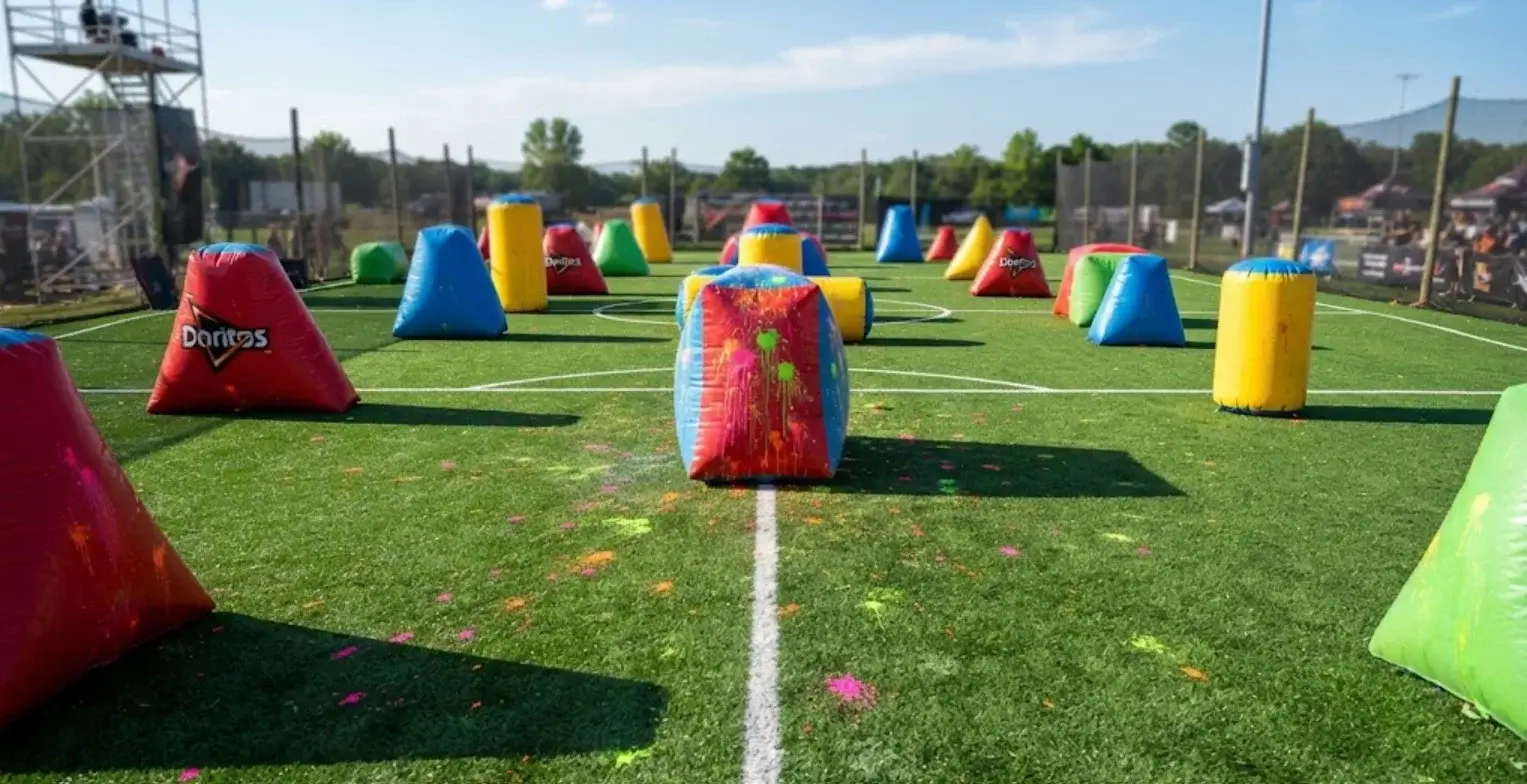
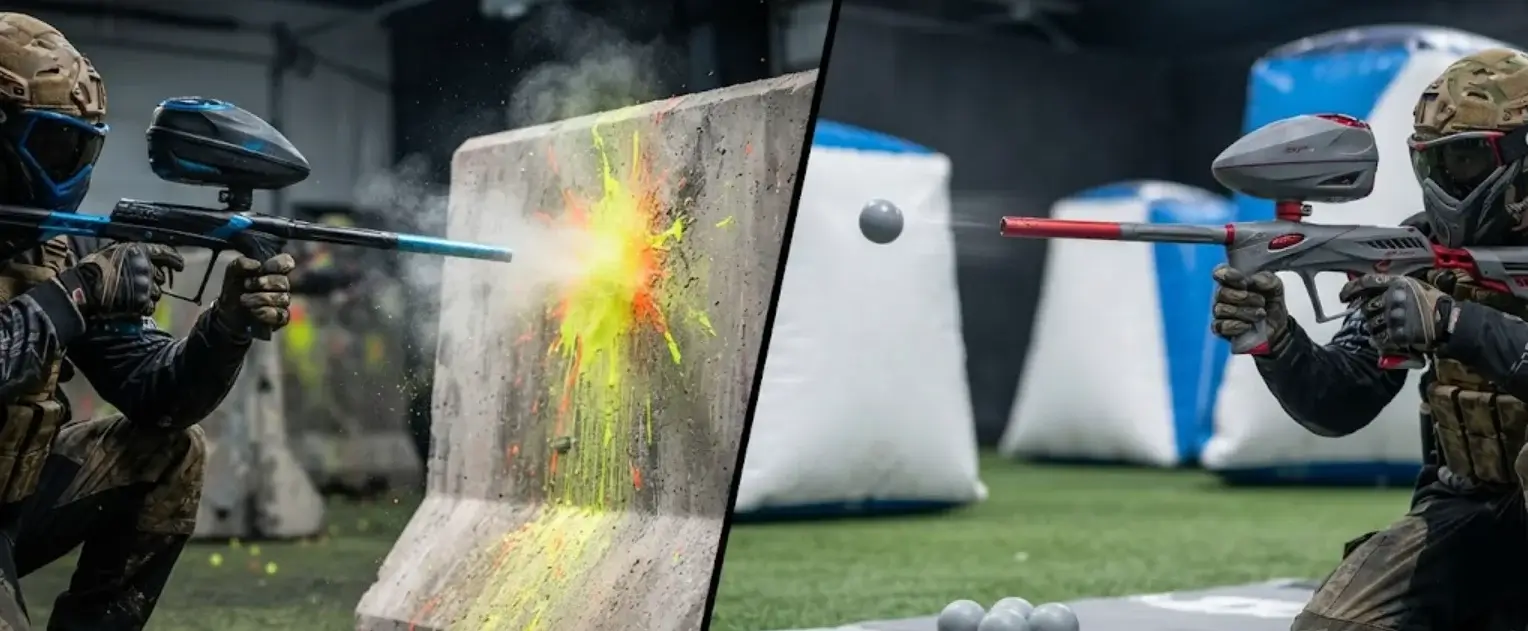
Recreational speedball happens at local fields on inflatable bunker setups, often called airball fields because the bunkers are air-filled rather than built from wood or plywood. Competitive speedball is what you see at events run by organizations like the National XBall League (NXL), where the same core format gets refined into a professional sport complete with rulebooks, referees, and broadcast coverage on outlets like ESPN2.
If someone asks what separates speedball from paintball in general, the honest answer is that speedball is paintball, just distilled into its most athletic, spectator-friendly form.
How Does Speedball Paintball Work?
A speedball match starts with both teams locked into starting boxes at opposite ends of a symmetrical field. On the buzzer, players break out toward bunkers, fighting for position before the other team can claim the same ground.
Team sizes vary by format. Older tournament divisions ran 5-man and 7-man speedball, where a full team lined up and played until eliminated or until the point clock expired. Modern professional paintball has mostly shifted to smaller, faster formats built around constant action rather than long standoffs.
The most common structure today is X-Ball, played in a race-to format. Instead of one long game, teams play back-to-back points, each roughly two minutes long, and the first team to reach a target number of points wins the match. A point ends when one team eliminates every opposing player, or when a team successfully pulls the flag and returns it to their base before time runs out.
That constant point-after-point rhythm is what makes X-Ball so watchable. There is no dead air. As soon as one point ends, the next one starts within seconds.
Speedball Paintball Rules Explained
Speedball rules exist for one reason: to keep a genuinely dangerous sport safe and fair while still allowing full speed play. The basics apply everywhere, from a Saturday rec league to a nationally ranked event, though tournament rulebooks get considerably more detailed.
Basic Rules
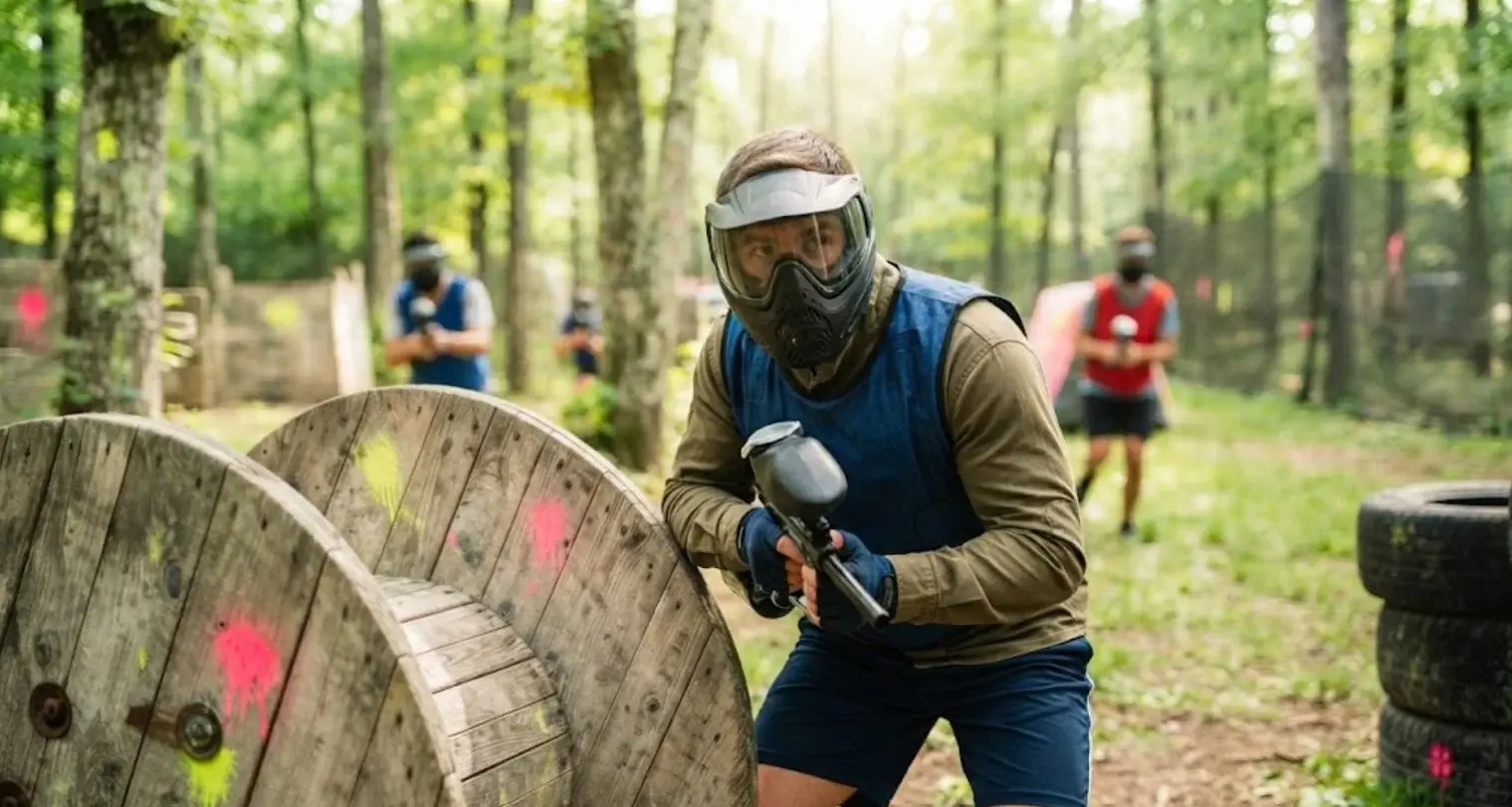
A player is eliminated when a paintball breaks on their body, gear, or marker and leaves a visible mark. Players call themselves out immediately, raise their marker overhead, and walk off the field toward the designated exit lane.
Referees confirm hits, resolve disputes, and enforce boundaries. Stepping outside the field lines or interfering with the game after elimination usually results in a penalty for the offending team. Most fields also enforce a minimum engagement distance to prevent point-blank shots at close range, since getting hit from a few feet away hurts considerably more than a shot from thirty yards out.
Tournament Rules
Organizations like the NXL publish full rulebooks covering everything from marker velocity limits (typically capped around 280 to 300 feet per second) to penalty structures for early breaks, uniform violations, or unsportsmanlike conduct. Divisional rules also govern which format a team plays, since amateur, semi-pro, and pro divisions do not all follow identical structures.
I will not pretend a blog post can replace an actual rulebook. If you are heading into ranked competition, read your league’s current rulebook cover to cover, because referees will hold you to it whether you read it or not.
Understanding a Speedball Field Layout
Every speedball field looks chaotic to a new player and completely readable to a veteran. The layout is symmetrical by design, which means whatever bunker advantage exists on one side exists in mirror image on the other.
Most modern competitive fields use inflatable bunkers, often built by manufacturers like Sup’Air, arranged in a pattern that gets published ahead of major tournaments so teams can study it before they ever step on the field. Learning to read a layout before the whistle blows is half the battle.
Common areas you will hear called out constantly during a match:
- Snake side: A low, winding row of bunkers along one edge of the field, used by players who crawl or slide their way toward the opposing team’s back players.
- Dorito side: Named for the triangular bunker shape, this lane usually sits opposite the snake and favors a more upright, aggressive push.
- Center bunker: A large bunker in the middle of the field that both teams contest early, since holding it often means controlling multiple shooting lanes at once.
- Starting box: The enclosed area where each team waits before the buzzer, often shown on layout diagrams as the very first reference point.
Field awareness sounds abstract until you play a few points. After that, you start seeing lanes and angles the way a chess player sees squares.
Speedball Paintball Positions Explained
Every speedball roster splits into roles, and while player names vary by team, the responsibilities stay fairly consistent across the sport.
| Position | Primary Job | Typical Field Area |
| Front player | Aggressive early pressure, forces opponents to react | Center bunker, forward bunkers |
| Mid player | Flexible support, fills gaps and covers rotations | Midfield lanes |
| Back player | Lane control, covering fire, protects the flag station | Back bunkers |
| Snake player | Crawls or slides the snake lane to flank the back players | Snake side |
| Dorito player | Pushes the Dorito lane aggressively for early eliminations | Dorito side |
| Lane shooter | Locks down a specific shooting lane to deny movement | Any bunker with a clear sightline |
Front players tend to take the most damage across a season, simply because they are the first ones exposed after the break. Back players survive longer on average but carry the pressure of covering an entire flank alone if their team loses ground early.
Speedball Paintball Strategy: How Teams Win Matches
Skill with a marker only gets a player so far. Speedball is a team sport first, and the teams that consistently win points are the ones who move and communicate like a single organism instead of five individuals doing their own thing.
Breakout strategy decides most points before they really start. The first three seconds after the buzzer, when each player claims their assigned bunker, often determines who controls the field for the rest of the point. Teams drill breakouts endlessly because a botched one is nearly impossible to recover from.
Lane shooting means locking a marker onto a gap between bunkers, so any opponent trying to cross it eats paint. A well-held lane can freeze half the opposing team in place without a single elimination, simply because nobody wants to risk the crossing.
Bunker play covers everything about how a player uses cover: leaning out to shoot, sliding into a new bunker, or bunkering an opponent directly by running straight at them until they are forced to surrender or take a point-blank hit. Aggressive bunker movement wins points quickly but carries real risk if it fails.
Communication ties all of it together. Constant calls like “back player up” or “snake is moving” let teammates react to threats they cannot personally see. Silent teams lose to loud, coordinated ones far more often than raw shooting accuracy would suggest.
Speedball Paintball Tips for Beginners
Nobody plays a clean first game of speedball. The goal early on is not to win; it is to survive long enough to start recognizing patterns.
- Move with purpose. Every step from one bunker to the next should have a reason, not just nervous energy.
- Communicate constantly, even if it feels awkward at first. Silence gets people eliminated.
- Learn angles before you learn trick shots. Knowing where you can and cannot be seen matters more than raw accuracy.
- Avoid unnecessary exposure. Leaning out for one extra second to “get a better look” is how most beginners get tagged out.
- Practice shooting while moving, since standing still to aim is rarely an option once a point actually starts.
- Watch experienced players, whether in person or on stream. Pattern recognition builds faster by watching than by guessing.
Speedball Paintball Drills to Improve Faster
Improvement in speedball comes from repetition under something close to real pressure, not from casual open play alone.
Shooting drills should include snap shooting practice, where a player leans out from cover for less than a second, fires, and resets. Pair that with basic accuracy drills at varying distances so muscle memory holds up even when your heart rate spikes.
Movement drills focus on bunker transitions and sliding. Practicing a clean slide into cover, rather than an awkward stumble, saves fractions of a second that matter enormously against a good opponent.
Team drills center on communication and coordinated breakouts. Running the same breakout pattern dozens of times until it happens without anyone thinking about it is what separates a team that panics under pressure from one that does not.
Best Paintball Gun for Speedball
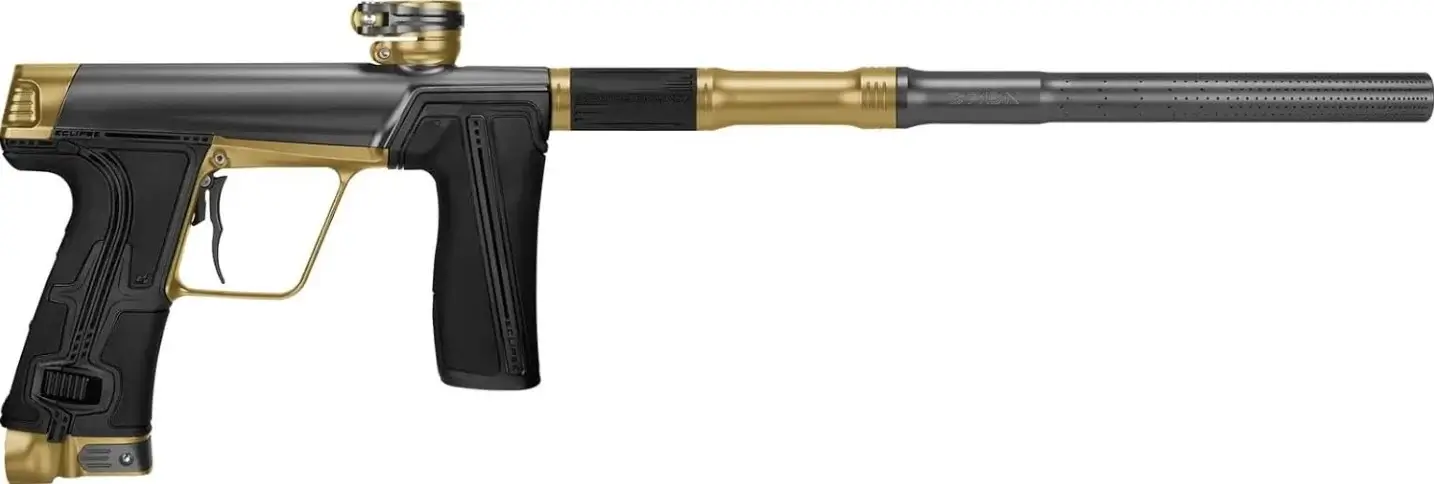
A speedball marker has to do things a woodsball gun never worries about: fire fast, cycle reliably under heavy trigger pull, and survive being dropped, dived on, and dragged through mud every single point. After testing and reading through enough gear reviews to lose count, the Planet Eclipse CS3 Pro Electronic Paintball Marker stands out as the strongest overall pick for serious speedball play.
Planet Eclipse CS3 Pro Electronic Paintball Marker
| Spec | Detail |
| Brand | Planet Eclipse |
| Model | CS3 Pro |
| Air System | Compressed air (HPA), hoseless transfer |
| Frame / Barrel Material | Aluminum |
| Weight | 2.1 lbs |
| Dimensions | 21.75″L x 1.75″W x 6″H |
| Grip Type | Wrap-around, tool-less |
| Operating Pressure | 95 to 105 psi |
| Barrel | S63 Pro FL 14.5″ insert barrel with CRBN Nano tip |
| Electronics | MME Electronics with onboard Bluetooth, OLED rear HUD |
| Included | Small parts kit, marker case, lubricant, three PWR barrel inserts (.681, .685, .689) |
| Warranty | 1-year manufacturer warranty |
What earns this marker its reputation is the OP Drivetrain. It fires consistently without constant tuning, which matters a lot when you are three points into a match and have zero time to fiddle with settings between breaks. The low operating pressure means quieter, softer shots on the gearbox and better efficiency per tank, so you are not swapping air as often mid-event.
The S63 Pro FL barrel, built in partnership with CRBN, keeps paint and debris out during dives thanks to its windowless design, and the three included inserts (.681, .685, .689) let you tune for whatever paint batch you are running that day. The OLED rear HUD and Bluetooth connectivity are small touches, but being able to check breach sensor status and battery life without pulling your hopper off saves real seconds during a match.
None of that means the CS3 Pro is right for everyone. It sits at a serious price point aimed at players who compete regularly, not someone testing the waters at a rec field twice a year. If you are just starting out, something like the Empire Axe 2.0 tends to get recommended as a more attainable entry into electronic tournament markers, while established lines like Dye Matrix and DLX Luxe sit somewhere between beginner and full pro gear depending on the specific model.
Speedball Paintball Equipment Setup
Beyond the marker itself, a handful of pieces round out a functional speedball setup. This is not a full buying guide, just what you actually need to play effectively.
- Tournament-grade electronic marker built to cycle fast and survive impact.
- High-speed electronic loader, since a standard hopper cannot keep up with tournament rates of fire and will jam or fall behind at the worst possible moment.
- HPA tank (compressed air), the standard air source in modern speedball, valued for consistent pressure compared to older CO2 setups.
- Speedball-specific paintballs, chosen to match your barrel bore size for consistent, accurate shots rather than random flight paths.
- Protective gear, including a full-seal paintball mask at all times on the field, plus padded gloves and knee or elbow pads for players who slide often.
A mask never comes off on an active field, full stop. That rule exists because eye injuries in paintball are entirely preventable and entirely not worth the risk of a moment’s carelessness.
Speedball vs Other Paintball Formats
Speedball is one lane of a much wider sport, and it is worth knowing how it differs from the alternatives before you commit gear and time to it.
| Format | Field | Pace | Equipment Focus | Best For |
| Speedball | Symmetrical, inflatable bunkers | Very fast, points under 2 minutes | Electronic markers, high-speed loaders | Competitive, reflex-driven players |
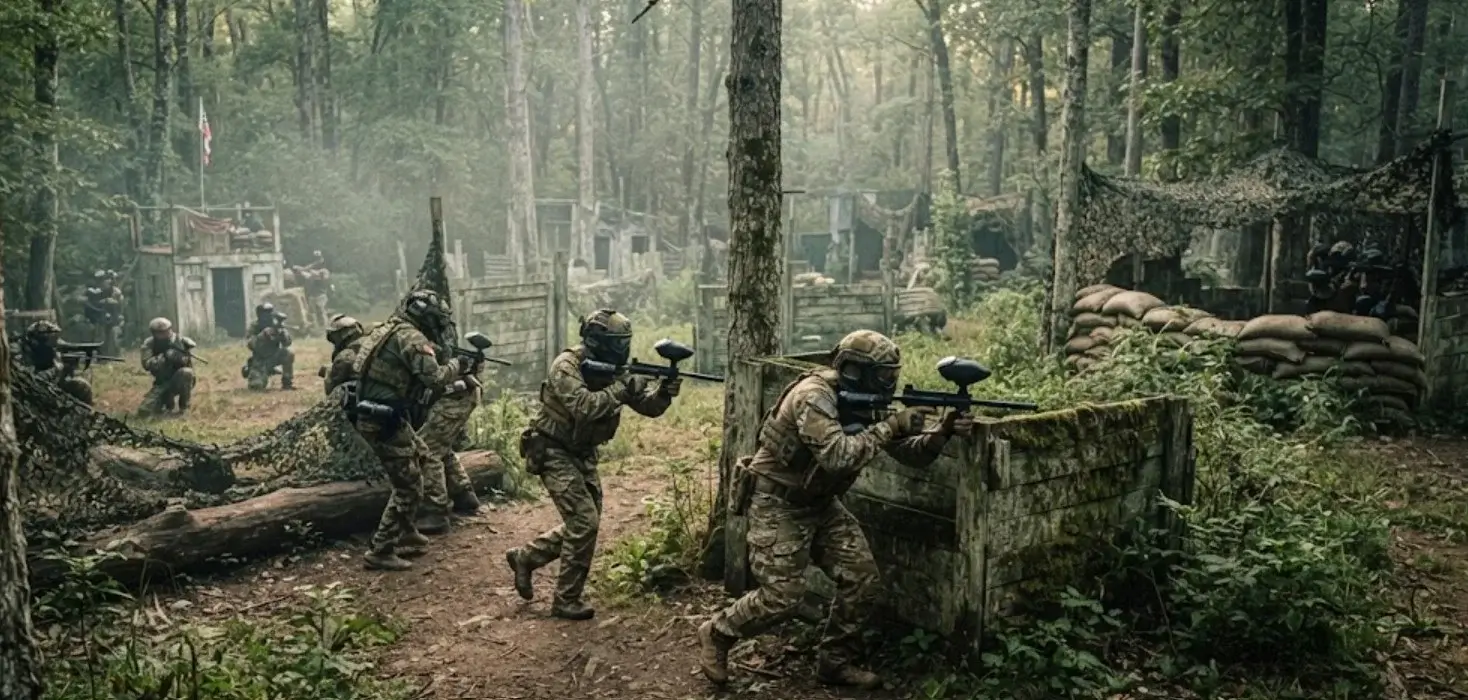
| Woodsball | Natural terrain, trees, bunkers | Slower, points can run 20+ minutes | Mechanical or electronic markers, camo gear | Players who prefer tactics over sprinting |
| Scenario Paintball | Large outdoor areas, mission objectives | Long games, hours per scenario | Realistic gear, larger air tanks | Roleplay-driven, team-story focused players |
| MagFed Paintball | Woodsball or scenario fields | Slower, more deliberate | Magazine-fed markers | Milsim fans who want realistic reload mechanics |
If nonstop action and constant decision-making appeal to you, speedball fits naturally. If you would rather stalk through trees and outthink an opponent over half an hour, woodsball or scenario play will feel far more rewarding.
Is Speedball Paintball Good for Beginners?
Speedball can absolutely work as a starting point, but it is not the gentlest introduction to the sport, and being honest about that upfront saves people frustration later.
What works in speedball’s favor for new players:
- Skills improve quickly because reps come fast and mistakes get punished immediately.
- The team-focused structure teaches communication habits that carry over to any format.
- The competitive environment builds confidence fast for players who enjoy pressure.
What makes it harder than a first paintball outing might otherwise be:
- The pace is genuinely faster than most people expect walking in.
- It demands more practice before a beginner feels comfortable, compared to a slower woodsball game.
- Physical intensity- diving, sliding, sprinting- is more demanding than casual recreational paintball.
My honest take: if your first paintball experience ever is a speedball field, expect a humbling day. If you have played a handful of recreational games already and want to level up, speedball is a great next step.
How Long Does a Speedball Paintball Game Last?
This depends heavily on which format you are asking about. Recreational speedball points on a local field often wrap up in one to three minutes, especially once one team gains bunker control early.
Tournament X-Ball formats standardize this further, with points typically capped around two minutes each. Since matches are races to a set number of points rather than a single long game, an entire X-Ball match can run anywhere from fifteen minutes to well over half an hour depending on how competitive the two teams are.
Older 5-man and 7-man formats without the X-Ball point structure could run longer per game, since a single round continued until elimination or objective completion rather than resetting on a clock.
Frequently Asked Questions
What is the difference between speedball and regular paintball?
Speedball is a specific competitive format within the wider sport of paintball. It uses symmetrical fields with inflatable bunkers and emphasizes speed and reflexes, while general recreational paintball often takes place on woodsball-style fields with a slower pace.
Is speedball harder than woodsball?
Physically and reflex-wise, most players find speedball more demanding since points move fast and mistakes get punished almost instantly. Woodsball tests patience, stealth, and long-range tactics instead, so “harder” really depends on which skill set you already lean toward.
What size field is used for speedball paintball?
Sizes vary by venue and league, but competitive fields are generally symmetrical and compact enough that bunker-to-bunker engagements happen at close to medium range rather than long-distance sniping.
Do you need an electronic marker for speedball?
It is not strictly required at a casual rec level, but tournament divisions almost universally use electronic markers because of their faster, more consistent rate of fire. A mechanical marker will put you at a real disadvantage in ranked competition.
Can beginners play speedball?
Yes, plenty of players learn the sport starting on a speedball field. Just go in expecting a steep first few sessions, rent gear before buying anything expensive, and lean on more experienced teammates to learn positioning early.
Final Takeaway
Speedball paintball rewards players who put in the reps. Nobody walks onto an airball field their first day and reads lanes like a five-year veteran, and that is fine. Learn the field, learn your position, communicate more than feels natural, and the rest starts clicking faster than you would expect.
Whether you are picking your first electronic marker or just trying to understand what your teammates are yelling about mid-point, the fundamentals in this guide hold up whether you are on a Saturday rec field or a ranked NXL event. For more on how speedball stacks up against woodsball, scenario play, and everything else under the paintball umbrella, keep exploring the rest of Paintball Renegade.
Further reading: National XBall League (NXL), the current major tournament organization for competitive speedball in the US and Europe.