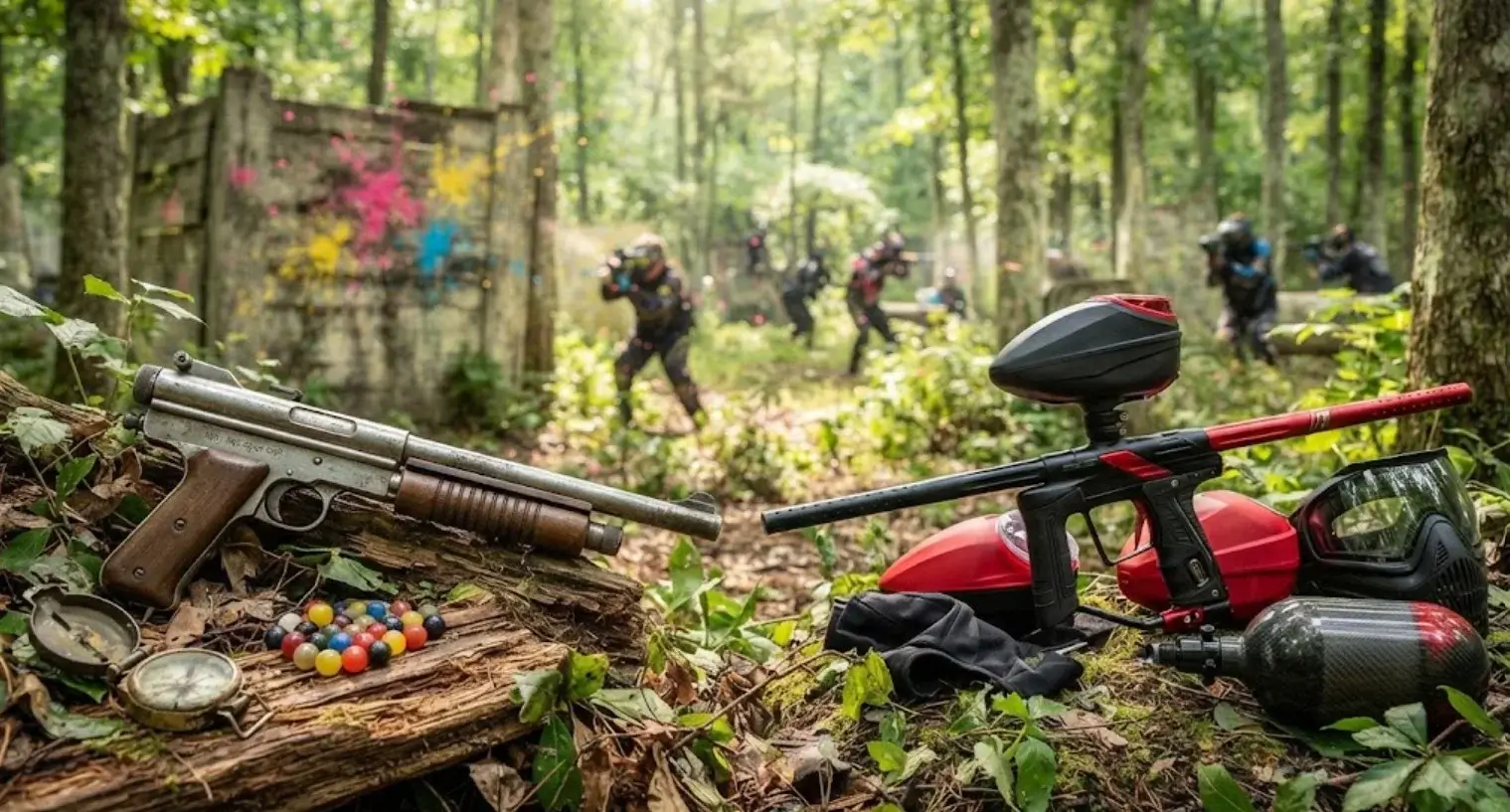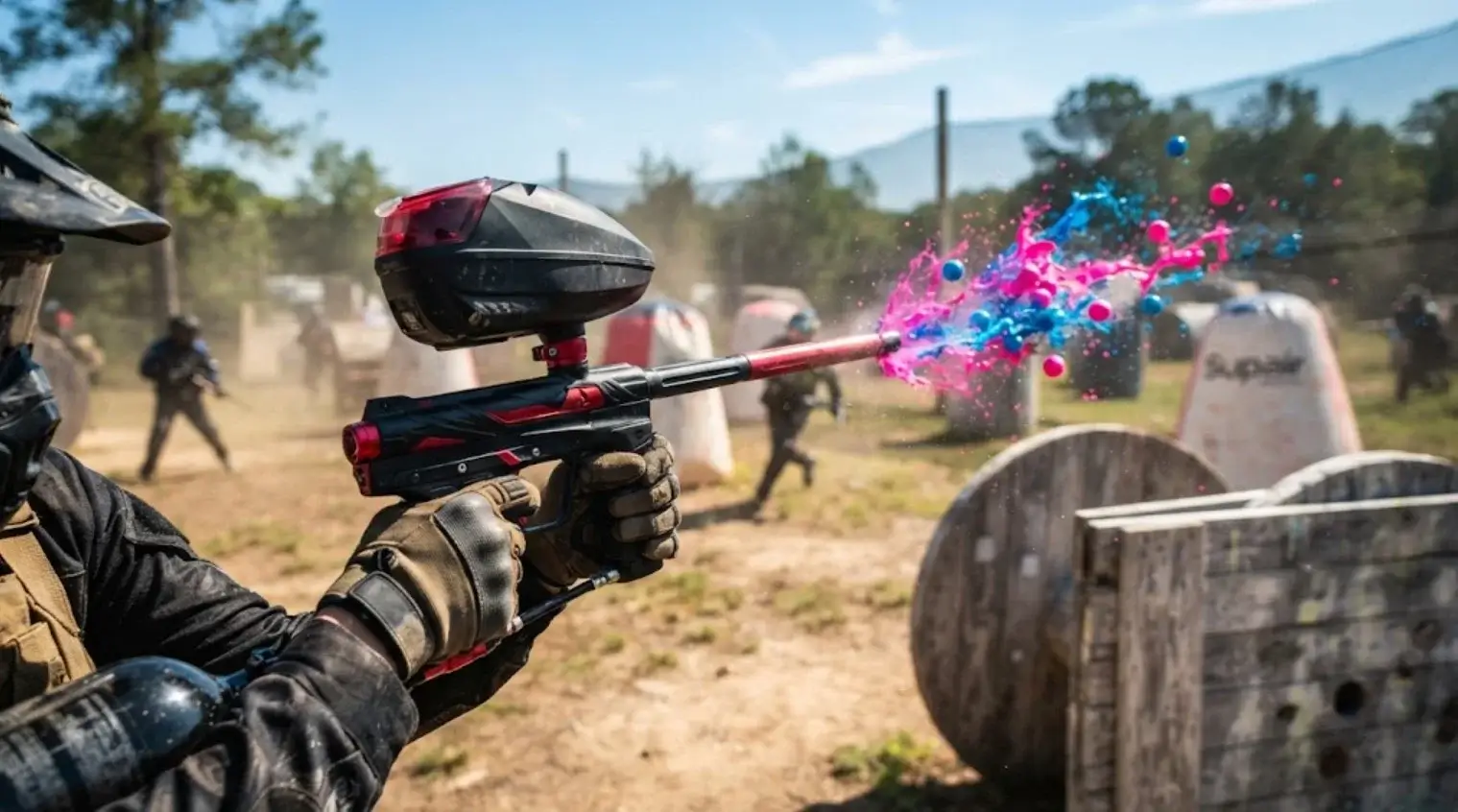
Paintball began as a practical way to mark trees and livestock, not as a sport. In 1981, that equipment became part of an experimental survival game in the New Hampshire woods. From there, the National Survival Game, commercial paintball fields, marker manufacturers, professional leagues, and a global player community transformed a simple idea into a worldwide activity.
Understanding the history of paintball also explains why modern equipment differs so much between woodsball, speedball, magfed, and scenario play. The marker, hopper, air system, mask, and field environment all developed in response to how players wanted to play.
Where Did Paintball Originate?
Paintball originated in the United States, with its recreational history centered on New Hampshire. However, the equipment used during the first game came from an earlier marking-gun industry.
The origins of paint-marking equipment
Before paintball became a recreational sport, marking devices were used in forestry and agriculture. Rangers could mark trees from a distance, while farmers and ranchers could identify livestock without approaching every animal.
The Nelson Paint Company became closely associated with this technology. Its marking systems used paint-filled capsules propelled by compressed gas. These devices were practical tools, but they provided the foundation for what later became known as the paintball marker or paintball gun.
The earliest equipment was not designed for players to compete against one another. It was designed to place a visible mark on a distant object. That original purpose is one reason the term “marker” remains preferred by many experienced players.
Historical accounts describe early development involving Charles Nelson, the Nelson Paint Company, and several marker designs. The Crosman 707 is often discussed as an early, commercially unsuccessful step, and the device that followed became known by more than one name, including the Nel-Spot 007 and, in some accounts, the “splotch marker.” Because surviving accounts do not always agree on the exact development and marketing sequence, or even on which name belongs to which model, these early equipment claims should be presented carefully rather than as a simple single-inventor story.
The survival game concept
The idea for paintball as a game came from a conversation between Hayes Noel and Charles Gaines. The two debated whether a city person or someone with outdoor experience would have better survival skills in the wilderness.
Their discussion eventually became a practical experiment. The challenge was finding a safe way for people to test awareness, movement, and survival instincts without using real weapons. The paint-marking gun provided a possible solution.
Bob Gurnsey helped turn the idea into an organized activity. He contributed to the rules, equipment planning, and later commercial development. For that reason, Charles Gaines, Hayes Noel, and Bob Gurnsey are usually identified as the central creators of paintball as a recreational game, while Charles Nelson is associated with the earlier marker technology.
The First Paintball Game in 1981
The first recreational paintball game took place on June 27, 1981, in the New Hampshire woods. Historical accounts commonly place the event near Henniker, although some references connect the area with Rochester or Sutton, New Hampshire. The safest description is the New Hampshire woods near Henniker and the surrounding region.
Twelve people took part in the game. The equipment included Nel-Spot 007 markers, paint capsules, basic eye protection, maps, and outdoor clothing. The participants were divided into groups with different levels of outdoor experience, reflecting the original city-versus-country survival debate.
The format was based on capturing flags. Players had to move through a large wooded area, locate flag stations, and collect flags while avoiding being marked by opponents. This was not modern speedball, and it did not resemble a professional tournament. It was a small outdoor experiment that combined recreation, navigation, competition, and the survival game concept.
Ritchie White, a New Hampshire forester, won the first game by capturing the required flags without firing a shot. His result became one of the most recognizable paintball history facts because it demonstrated that the original game rewarded movement and awareness as much as direct confrontation.
The first event answered the question that had started the entire project. It also created a repeatable activity that other people could try. Once participants began sharing the story, interest grew beyond the original group.
How Paintball Became a National Survival Game
The first game was not immediately a commercial sport. Its growth began after media coverage introduced the concept to a much wider audience.
Bob Jones, one of the original participants, helped publicize the event through an article in Sports Illustrated. Readers wanted to know how they could play, what equipment they needed, and whether similar games could be organized in other locations.
Charles Gaines, Hayes Noel, and Bob Gurnsey recognized that the survival game could become a business. They began offering starter packages that included a marker, paintballs, protective equipment, and written rules. The packages helped standardize the experience and allowed people outside New Hampshire to organize their own games.
The activity was marketed under the name National Survival Game, often shortened to NSG. NSG Inc. became one of the most important early organizations in paintball history. Its relationship with the Nelson Paint Company helped connect the new recreational activity with the companies already producing marking equipment.
Bob Gurnsey also helped establish an early commercial field in New Hampshire in 1982. National Survival Game later used licensing and franchise arrangements to support additional fields. This was a major change in paintball’s development because players no longer needed access to private woodland or the original group of founders. They could visit a commercial paintball field and participate in a more structured experience.
Bob Gurnsey remains the figure most directly associated with organizing the first game and commercializing National Survival Game, a role documented consistently across historical accounts, interviews, and his own archived recollections of the sport’s founding years.
Paintball History Timeline
| Year | Milestone |
| Before 1981 | Marking guns are used for forestry and livestock applications. |
| 1970s | Hayes Noel and Charles Gaines develop the idea of testing survival skills through a game. |
| 1981 | The first recreational paintball game is held in the New Hampshire woods. |
| 1981–1982 | National Survival Game begins selling equipment packages and rules. |
| 1982 | One of the first commercial paintball fields opens in New Hampshire. |
| 1983 | The first major National Survival Game championship is held. The Unknown Rebels from Canada win the event. |
| Mid-1980s | Paintball expands beyond its original survival-game identity and spreads internationally. |
| Late 1980s | More commercial fields, equipment manufacturers, and organized competitions appear. |
| 1990s | Paintball experiences a major growth period, supported by new markers, magazines, sponsorships, and professional events. |
| 2000s | Professional paintball and the broader paintball industry continue expanding. |
| Modern era | Paintball develops through recreational fields, professional circuits, collegiate programs, scenario events, and digital communities. |
The timeline is useful as a reference, but the important story is the progression from marking technology to organized recreation and then to competitive sport.
The Evolution of Paintball Markers
The history of paintball markers follows the changing needs of players. Early games used simple pump-action equipment. As fields became more commercial and competition became more organized, manufacturers developed markers that could feed paint more consistently, use air more efficiently, and support faster play.
The Nel-Spot 007 and pump-action beginnings
The Nelson Nel-Spot 007 is the marker most closely associated with the 1981 survival game. It was compact, manually operated, and originally connected to the agricultural marking-gun market.
Its historical importance is greater than its relevance to modern competitive performance. The Nel-Spot 007 made the first game possible, but modern players should not judge it by the standards of current markers. It offered a slower, simpler experience with fewer components and fewer upgrade options.
For historical recreation, pump play, or collectors, early markers remain interesting. A modern player looking for maximum feeding speed, electronic control, or broad accessory compatibility would usually need a later design.
The move toward mechanical semi-automatic markers
As paintball expanded, mechanical semi-automatic markers became more common. Designs from companies such as Tippmann Arms Company, Airgun Designs, and other marker manufacturers helped move the sport beyond its pump-action beginnings.
The Tippmann 68 Special became an important name in the development of practical field markers. The Automag, also written as AutoMag, became known for its distinctive mechanical design and role in competitive marker history. The Autococker developed a large following among players who valued customization and mechanical tuning, while the Spyder marker became widely associated with accessible entry-level and recreational equipment.
These markers changed the experience of play in several ways:
- They reduced the need to manually pump after every shot.
- They supported faster follow-up shots.
- They encouraged new hopper and loader designs.
- They made marker balance and air-system placement more important.
- They created a market for replacement parts and upgrades.
Mechanical markers remain useful for woodsball, scenario play, recreational fields, and players who prefer simple controls. They can also be easier to understand when a player wants to learn how the marker’s major systems work.
Their tradeoff is that mechanical systems still contain wear components such as O-rings, seals, detents, and moving parts. A marker can be mechanically durable without being maintenance-free. Air leaks, worn seals, damaged detents, and feed problems still require attention.
Hopper systems and air-system development
Early paintball equipment relied on relatively simple gravity-fed loading. As the sport became faster, hopper systems improved so markers could receive paint more reliably during active play.
This development mattered because marker performance depends on the entire system, not only the body or trigger. A high-performance marker paired with an unsuitable hopper may still experience feed issues. Paint quality, loader design, detent condition, and the paint-to-barrel match can also affect practical consistency.
Air systems evolved at the same time. CO2-powered markers were common during paintball’s early and growth periods, while compressed air systems and HPA tanks became increasingly important for consistency and modern competitive use.
CO2 can be practical for some older recreational markers, but cold weather may reduce its consistency. HPA is generally preferred for modern electronic markers and many newer mechanical designs, but the marker must be compatible with the tank and regulator system. Players should follow the manufacturer’s specifications and field requirements rather than assuming that every marker can safely use every air source.
Tank weight and placement also influence balance. A technically capable setup may feel uncomfortable if the tank makes the marker rear-heavy or difficult to shoulder. The real field benefit of an air system depends on compatibility, balance, refill access, and the player’s style.
Electronic markers and professional competition
Electronic markers became increasingly influential as competitive paintball developed. They introduced electronic control systems, battery requirements, and more specialized trigger and firing systems.
Their advantages can include:
- Fast trigger response
- Consistent electronic control
- Compatibility with competitive loaders
- Adjustable player interfaces on some models
- Reduced effort during extended play
Their limitations include:
- Dependence on batteries
- Greater sensitivity to water and improper handling
- More complicated troubleshooting
- Additional electronic components
- Possible restrictions under field or tournament rules
An electronic marker is not automatically a better choice for every player. It may benefit a speedball player or an experienced competitor, while a recreational woodsball player may gain more from a durable mechanical marker with simpler maintenance.
Smart Parts, JT Paintball, Procaps, Tippmann, and Airgun Designs all represent different parts of paintball’s equipment-industry development. Their products, designs, and business histories helped shape the marketplace, but no single brand explains the entire evolution of paintball markers.
The Development of Masks and Protective Equipment
Protective equipment developed alongside the sport. The first players used basic eye protection, but commercial fields needed more dependable equipment for repeated use by larger groups.
Dedicated paintball masks gradually added:
- Full-face protection
- Improved goggle systems
- Better ventilation
- More comfortable fit
- Wider field of view
- Replaceable lenses
- Thermal-lens options to reduce fogging
Mask comfort became a practical issue as games became longer and fields became more organized. A mask that pinches, restricts vision, or fogs easily can affect a player’s experience more than a small marker upgrade.
A thermal lens can help reduce fogging by using a dual-lens design, but it is not a guarantee against condensation. Ventilation, humidity, temperature, face fit, and how often the player wipes or touches the lens all matter. A mask should fit securely and remain comfortable without creating gaps around the face.
Eye and face protection is never optional in an active paintball area. Players should wear an approved paintball mask whenever markers are active and follow the field’s rules for barrel covers, safe areas, and chronograph checks.
Paintball’s Recreational Growth in the 1980s and 1990s
During the 1980s, paintball moved beyond the original survival game and became an organized recreational sport. Commercial paintball fields appeared across the United States and Canada, followed by fields in the United Kingdom, Europe, Australia, and other regions.
The growth period created several different styles of play. Large wooded fields supported woodsball and scenario events, while smaller fields encouraged faster games and more structured competition. Magfed play later developed around magazine-fed equipment and a different approach to ammunition capacity and marker design.
These categories are not simply marketing labels. They influence the equipment a player needs:
- Woodsball players often prioritize durability, weather tolerance, balance, and simple maintenance.
- Speedball players may prioritize weight, electronic systems, loader performance, and tournament legality.
- Magfed players may value magazine compatibility, realistic handling, and controlled paint use.
- Scenario players often choose equipment based on reliability, long-session comfort, and the demands of the event.
The 1990s brought a major paintball boom. New marker manufacturers entered the marketplace, paintball magazines expanded, sponsorships became more visible, and professional events attracted larger audiences. Tippmann and Spyder became familiar names among recreational players, while higher-end mechanical and electronic markers shaped competitive paintball.
Paint quality also became more important as equipment became more advanced. A marker may be capable of consistent performance, but poorly stored, misshapen, or improperly sized paint can contribute to breaks, inconsistent feeding, and poor results. Equipment specifications cannot eliminate the effects of unsuitable paint.
The History of Professional Paintball
Professional paintball developed gradually from local competitions and organized field events. Dedicated teams began traveling to compete, while sponsors, manufacturers, media companies, and tournament organizers built a more formal competitive structure.
The professional era
The National Professional Paintball League, or NPPL, became one of the organizations associated with professional tournament paintball. Major League Paintball, or MLP, and Paintball Sports Promotions, commonly known as PSP, also contributed to the organization and promotion of competitive events.
Professional circuits influenced equipment development. Teams needed markers, loaders, tanks, protective equipment, and accessories that could withstand repeated use and demanding schedules. Manufacturers responded with lighter designs, electronic systems, improved feeding technology, and specialized high-performance markers.
That development also created a common buyer mistake: assuming that professional equipment is automatically the best choice for recreational play. A premium electronic marker may offer advantages in a competitive setting, but it can also require batteries, more careful maintenance, and a larger investment in compatible equipment.
A reliable mechanical marker may be the more sensible choice for a casual player who visits a field occasionally. The correct upgrade depends on the player’s actual limitations. If the main problem is a fogging mask, an expensive marker will not solve it. If the issue is feed inconsistency, the hopper, paint, detents, or barrel condition may deserve attention before the marker body.
Collegiate and amateur paintball
The National Collegiate Paintball Association, or NCPA, helped support collegiate paintball and provided another path for organized team competition.
Collegiate and amateur programs are important because they connect recreational players with more structured competition. They also help preserve the paintball community by giving players opportunities to form teams, attend events, and continue playing beyond occasional field visits.
Paintball in the 2000s and the Digital Era
The 2000s paintball expansion continued the sport’s development through commercial fields, professional circuits, equipment manufacturers, sponsorships, and media coverage.
At the same time, paintball media began changing. Print magazines were joined, and in some cases replaced, by websites, forums, video platforms, and social media. Digital communities made it easier for players to compare markers, find replacement parts, discuss air systems, and follow teams and events.
This shift helped preserve the stories of early paintball enthusiasts and paintball pioneers. It also created more information for buyers, although not all online advice is equally reliable. Manufacturer manuals, field rules, recognized tournament organizations, and established technical resources are better references for safety and compatibility than unsupported forum claims.
Modern paintball includes recreational sport, competitive paintball, woodsball, speedball, magfed play, scenario events, collegiate programs, and professional competition. The global paintball community is diverse, and no single marker type or playing format represents the entire sport.
Paintball’s Evolution From Survival Game to Global Sport
Paintball’s history can be understood in four stages:
- Marking technology: Forestry and livestock marking guns created the equipment foundation.
- Survival game: Gaines, Noel, and Gurnsey turned that technology into the 1981 New Hampshire game.
- Recreational sport: National Survival Game and commercial fields made the activity accessible to the public.
- Competitive industry: Marker manufacturers, paintball brands, leagues, sponsorships, and professional circuits expanded the sport worldwide.
The equipment changed because the players and fields changed. Pump-action markers suited the original experimental games. Mechanical and semi-automatic markers supported expanding recreational play. Electronic markers, advanced hopper systems, and compressed air helped professional paintball develop.
That does not mean newer equipment makes older equipment irrelevant. A player choosing gear today should start with playing style, field type, air availability, comfort, maintenance expectations, and replacement-part support. Specifications matter, but actual field value depends on whether the equipment solves a real problem.
Paintball History Facts
- Paintball’s recreational origin dates to 1981.
- The first game was played in the New Hampshire woods.
- Hayes Noel and Charles Gaines developed the original survival-game idea.
- Bob Gurnsey helped organize the first game and commercialize National Survival Game.
- Charles Nelson and the Nelson Paint Company were associated with early paint-marking equipment.
- The Nel-Spot 007 was used in the first recreational paintball game.
- Ritchie White won the first game without firing a shot.
- National Survival Game helped establish early commercial paintball fields.
- Paintball expanded internationally during the 1980s.
- The 1990s brought major growth in markers, media, sponsorships, and competition.
- Professional paintball developed through leagues, tournament promoters, teams, and manufacturers.
Frequently Asked Questions About Paintball History
When was paintball invented?
Paintball as a recreational activity began with the first game on June 27, 1981. The paint-marking equipment used during that game existed earlier and was originally developed for forestry and livestock applications.
Who invented paintball?
Charles Gaines, Hayes Noel, and Bob Gurnsey are generally associated with creating paintball as a recreational game. Charles Nelson is associated with the earlier paint-marking technology that made the game possible.
Who invented the paintball gun?
Charles Nelson and the Nelson Paint Company played an important role in developing early paint-marking guns. The Nelson Nel-Spot 007 became the marker most closely associated with the first paintball game.
Where was paintball invented?
Paintball was invented as a recreational game in New Hampshire, United States. Historical accounts commonly associate the first game with the Henniker area and nearby New Hampshire woods, although references to Rochester and Sutton also appear.
Why was paintball invented?
Paintball was invented to settle a debate about whether city dwellers or people with outdoor experience would have better survival skills in the wilderness.
When was the first paintball mask invented?
Early paintball players used basic eye protection. Dedicated paintball masks and full-face goggle systems developed as commercial fields expanded and the sport required more consistent protective equipment.
How did paintball become a professional sport?
Paintball grew from informal games into commercial field play, organized championships, traveling teams, sponsorships, professional circuits, and leagues such as the NPPL and PSP.
Are older paintball markers still useful?
Some older mechanical and pump markers remain suitable for recreational play, historical collections, pump events, woodsball, and players who value simplicity. Buyers should check air-system compatibility, replacement-part availability, seal condition, and field restrictions before relying on an older marker.
Is an electronic marker better than a mechanical marker?
Neither is universally better. Electronic markers may suit speedball and competitive players who value fast response and advanced control. Mechanical markers may be preferable for players who want simpler operation, lower battery dependence, and easier troubleshooting.
Conclusion
The history of paintball began with marking equipment and a debate between friends, but its development depended on much more than the first game. Charles Gaines, Hayes Noel, and Bob Gurnsey created the original recreational concept. Charles Nelson and the Nelson Paint Company helped provide the equipment foundation. National Survival Game, commercial fields, manufacturers, media, professional leagues, and players then shaped the sport’s expansion.
For buyers and gear researchers, that history offers a useful lesson: the best equipment depends on how and where a player intends to use it. A woodsball or scenario player may value durability, balance, and simple maintenance. A speedball player may need electronic control, a compatible loader, and tournament-legal equipment. A magfed player may prioritize magazine systems and realistic handling.
Before upgrading, identify the actual limitation. Better equipment can improve a setup, but only when the marker, hopper, tank, barrel, paint, mask, and playing environment work together. Above all, use compatible components, follow field rules, wear an approved mask in active areas, observe chronograph and velocity requirements, use barrel covers in safe areas, and maintain air tanks according to manufacturer instructions and hydrostatic testing requirements.
Paintball has evolved considerably, but its original appeal remains familiar: outdoor recreation, team-based competition, and the challenge of making decisions under pressure.