
Buying paintball gear gets expensive fastest when every accessory starts looking essential. It is not. A useful paintball loadout combines the equipment needed to shoot reliably, carry paint, stay protected, move comfortably, maintain the setup, and transport everything without creating unnecessary weight or complexity.
For beginners, the goal should not be to own the most paintball equipment. It should be to build a compatible setup that fits properly and solves the problems you actually encounter on the field. At Paintball Renegade, that is the standard I use throughout this guide.
Paintball Gear Checklist: What Equipment Do You Need?
A complete paintball equipment list can become surprisingly long, but the important items fall into a few clear groups.
Essential Paintball Gear
- Paintball marker or paintball gun
- Compatible HPA or CO2 air source
- Hopper or loader
- Paintballs
- Properly designed, field-approved paintball mask
- Barrel cover or other field-approved barrel-blocking device
Paint-Carrying Gear
- Paintball pods
- Pod pack or harness
- Magazine pouches for magfed setups
Protective Gear
- Gloves
- Knee pads
- Elbow or forearm pads
- Chest protector or padded compression layer
- Neck protector
- Slide shorts where useful
Paintball Apparel
- Paintball pants
- Paintball jersey
- Playing shirt
- Cleats, trail shoes, or suitable boots
- Headband
- Beanie
- Shorts or compression layer
Maintenance and Paintball Accessories
- Barrel swab
- Squeegee
- Microfiber cloth
- Cleaning kit
- Spare O-rings
- Correct marker lubricant
- Basic tool kit
- Repair kit
- Spare batteries
- Tank cover
- Marker stand
- Marker sling where appropriate
- Chronograph access
Storage and Transport
- Paintball gear bag
- Marker case
- Barrel storage
- Pod storage
- Separate storage for dirty clothing
A beginner does not need to buy everything on this paintball gear checklist at once. Start with safety, a dependable shooting system, and basic comfort. Add paintball accessories after actual playing experience identifies a reason for them.
How to Choose Paintball Gear That Works Together
Compatibility matters more than matching logos.
A marker from one company can work perfectly well with a loader, tank, harness, and barrel system from several other brands. The important question is whether the interfaces and operating requirements match.
Check Marker and Air-System Compatibility
Do not assume every paintball marker accepts both HPA and CO2.
Older mechanical and blowback designs are often more tolerant of CO2. Some modern electronic markers specifically require compressed air.
DYE, for example, currently instructs owners to use compressed air or nitrogen in its markers and not CO2. Its published guidance also states not to exceed 850 psi input pressure.
By comparison, the Tippmann Cronus is designed to operate with either CO2 or compressed air, giving recreational buyers more flexibility.
Check the marker manual before connecting an unfamiliar air system.
Regulator Output Matters
An HPA tank may store air at 3000 or 4500 psi, but the marker does not receive that full pressure. The tank regulator reduces it to a usable output pressure.
That output needs to suit the marker.
High-output paintball regulators commonly operate around the traditional 800 to 850 psi range, while some equipment is intended for lower output. Never select or modify a regulator based only on assumptions about what “should work.”
Check Hopper and Feedneck Fit
Most modern hopper-fed markers use adjustable clamping feednecks, but fit still matters.
The loader should:
- Sit firmly without rocking
- Avoid requiring excessive feedneck pressure
- Stay low enough for good balance
- Feed reliably at the marker’s actual rate of fire
- Be removable without damaging the feedneck
An expensive electronic loader does not automatically improve a basic mechanical marker. If a gravity-fed hopper already feeds reliably at the player’s firing rate, the money may be better spent elsewhere.
Check Barrel Threading
Paintball barrels are not universally threaded.
Autococker-style threads are common, but other thread patterns exist. Before buying a barrel or barrel kit, verify the marker’s thread pattern.
If using inserts, also make sure the barrel back, inserts, and barrel tip belong to compatible systems.
Magfed Compatibility Is More Restrictive
Magazine-fed equipment requires additional attention.
Check:
- Exact marker model
- Magazine type
- Magazine generation
- First-strike compatibility where relevant and field permitted
- Magazine pouch dimensions
- Remote-line setup
- Stock clearance
- Air-source placement
A magazine that looks similar may still not function in another marker platform.
Think About Balance, Not Just Weight
Two setups can weigh nearly the same yet feel completely different.
A long, heavy tank moves weight behind the marker. A large loader places weight high and toward the center. Tactical accessories can pull the marker forward.
Smaller-framed players should pay particular attention to tank length and reach. A technically light setup can still feel awkward if the tank makes the shooting position too long.
Replacement Parts Matter
A marker that performs beautifully when new can become frustrating if basic detents, seals, regulator seats, eye components, or replacement boards become difficult to source.
Before buying discontinued or obscure paintball equipment, check whether common service parts remain available.
Paintball Markers: Choose for Reliability and Playing Style
For most buyers, the important questions are straightforward. Is the marker reliable? Is it comfortable to hold? Can you get replacement parts? Is routine maintenance manageable? Does it suit the type of paintball you actually play?
Mechanical markers generally make sense for players who value simple operation and straightforward maintenance. Electronic markers add firing controls and performance features that become more useful in faster speedball and competitive setups. Magfed and pump markers serve more specialized playing styles.
Higher firing capability does not automatically make a marker better. A recreational player who values reliability may be happier with a simple mechanical setup than an electronic marker loaded with features they rarely use.
Marker To Consider: DYE DSR+
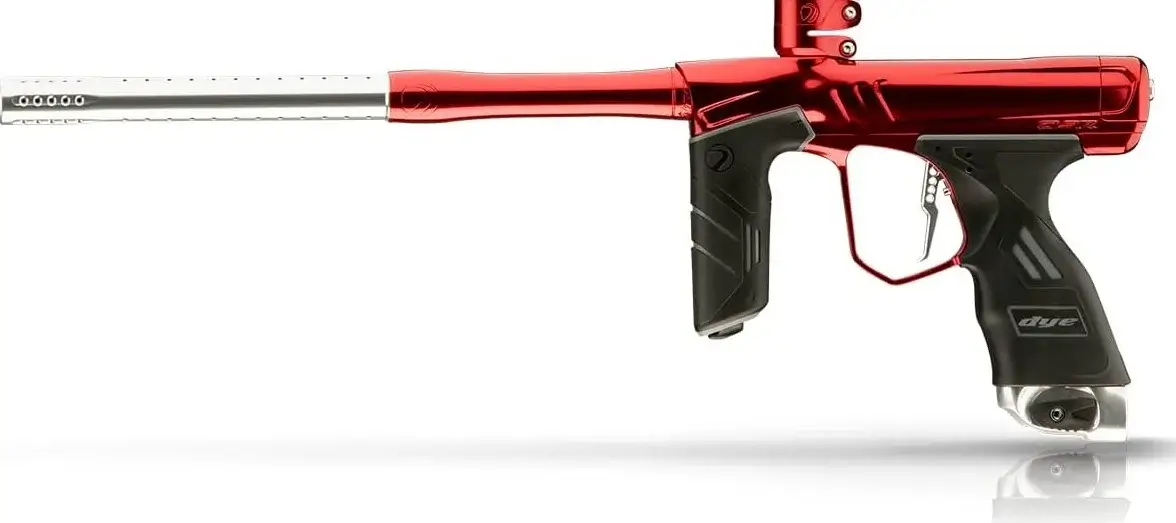
A recreational player moving beyond rental gear does not automatically need a tournament-level electronic marker. The DYE DSR+ makes more sense when the buyer specifically wants smoother electronic performance, adjustability, and tournament-oriented handling.
DYE continues to list the DSR+ within its marker range in 2026.
The DSR platform incorporates features including the ARC bolt system, Flex SFR solenoid, electronic MOS operating system, Leverlock feedneck, Ultralite 45 frame, and tool-less battery access.
What matters to a buyer is what those features change.
The electronic operating system and trigger arrangement suit fast, controlled shooting. Tool-less access reduces the hassle of routine battery and bolt servicing. The low-profile tournament layout also avoids the bulky furniture commonly seen on scenario-oriented markers.
Who it fits: Intermediate and experienced players, speedball players, and buyers who genuinely want an electronic tournament platform.
Who should skip it: A first-time recreational player who mainly needs a rugged, uncomplicated marker may get little practical value from its more advanced controls.
Compared with a simple mechanical marker, the DSR+ provides more performance tuning and electronic capability, but it also gives the owner more systems to understand and maintain.
The useful question is not whether the DSR+ is “better.” It is whether the player’s field format and playing frequency justify what it offers.
HPA Tanks, CO2, and Paintball Air Systems
Your air source powers the marker, so compatibility should come before capacity, pressure rating, materials, or appearance.
Most modern paintball setups use HPA, while some recreational markers also support CO2. Check the marker manufacturer’s requirements rather than assuming either system will work.
When choosing a paintball tank, focus on:
- Marker compatibility
- Tank size
- Overall weight
- Marker balance
- Regulator requirements
- Local refill availability
- How much air you realistically need
Aluminum HPA tanks are commonly chosen for budget-oriented setups, while frequent players may prefer lighter carbon-fiber systems. The detailed differences between HPA and CO2, 3000 psi and 4500 psi tanks, bottle materials, regulator types, and tank sizing are better handled in a dedicated paintball tank guide.
Tank To Consider: HK Army 48ci/3000psi Aluminum HPA Tank
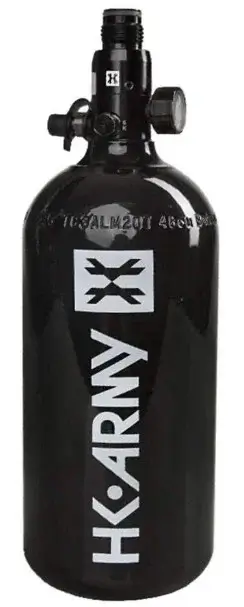
This is the kind of tank that makes sense when someone wants to move into refillable HPA without immediately buying a lightweight carbon-fiber system.
HK Army currently lists its 48ci/3000 psi aluminum system with an 800 psi output regulator and fill-level gauge.
The practical benefit is straightforward. It gives compatible markers a conventional HPA source while keeping the setup relatively simple.
The compromise is weight.
An aluminum bottle can make a marker feel noticeably heavier than many carbon-fiber alternatives, especially during long woodsball sessions or repeated speedball points. HK Army itself identifies weight as one of the main differences between typical aluminum 3000 psi and carbon-fiber 4500 psi systems.
Who it fits: Beginners, recreational players, backup setups, and buyers prioritizing functionality over minimum weight.
Who should skip it: Players already frustrated by a heavy rear end or competitive players trying to reduce total marker weight may benefit more from a lighter carbon-fiber system.
The 48ci/3000 setup is worth considering when affordability and compatibility matter more than shaving weight from the loadout.
Paintball Hoppers and Loaders
The hopper or loader keeps paint moving into the marker. The right choice depends mainly on how quickly your setup needs to feed.
A simple gravity-fed hopper can work perfectly well with many recreational and mechanical markers. Electronic loaders become more useful when a player’s firing rate starts exceeding what gravity feeding can handle reliably.
When comparing loaders, focus on:
- Reliable feeding
- Capacity
- Weight
- Profile
- Battery requirements
- Anti-jam features
- Ease of cleaning
- Replacement-parts availability
Do not choose a loader simply because it advertises an extremely high maximum feed rate. Reliable real-world feeding matters more than a specification your marker may never use.
Loader To Consider: DYE LT-R Electronic Loader
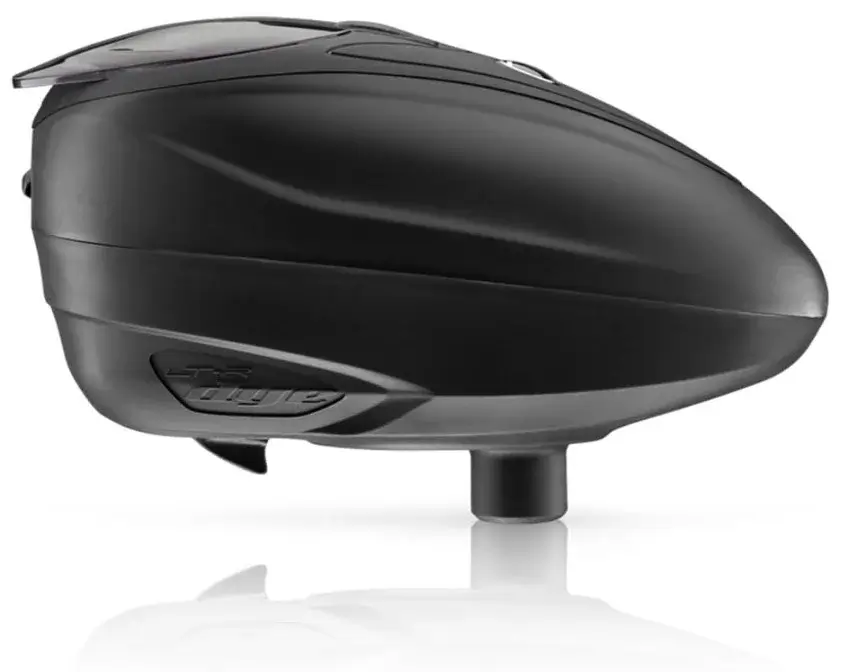
A player upgrading from a gravity hopper may notice the biggest improvement when shooting strings rapidly. Instead of depending entirely on paint falling into position, the LT-R’s powered Rotor system keeps feeding pressure on the paint.
DYE currently lists the LT-R with a 200-ball capacity, constant-feed Rotor technology, adjustable feed tension, built-in anti-jam release, and tool-less construction. It runs on three AA batteries.
That makes it particularly relevant for electronic markers and players whose firing pace has reached the limits of basic gravity feeding.
Who it fits: Intermediate players, speedball players, and owners of faster electronic markers who want dependable powered feeding.
Who should skip it: A casual player using a basic mechanical marker at a slow firing pace may gain little from adding electronics and batteries.
Compared with a gravity hopper, the LT-R improves feed control but increases complexity and weight.
It earns consideration because of feeding consistency, not simply because its advertised maximum feed rate is high.
Paintballs: Good Gear Still Needs Good Paint
Poor paint can make expensive equipment behave badly.
Paintballs vary in freshness, shell condition, diameter, brittleness, and storage history. Heat, moisture, cold, and rough storage can affect them before they ever reach your marker.
Watch for:
- Misshapen balls
- Oily or contaminated shells
- Visible cracking
- Swelling
- Flat spots
- Broken paint inside the bag
Some fields require players to buy field paint. Check before arriving with several bags you are not allowed to use.
Paint quality also affects barrel performance. A dirty barrel following one break can destroy consistency until it is cleaned.
Do not assume a new barrel is the answer whenever accuracy becomes poor. Inspect the paint first.
Pods and Pod Packs: Carry Enough Paint Without Carrying Too Much
Pods allow you to reload during play, while a pod pack or harness keeps them accessible.
The important decision is not how many pods the harness can technically hold. It is how much paint you can carry without hurting mobility or comfort.
Consider:
- Pod capacity
- Harness stability
- Waist fit
- Retention
- Reload access
- Strap or strapless design
- Actual paint consumption
- Added weight
Configurations such as 3+2, 4+3, and 5+4 give players different levels of carrying capacity. More capacity can help during longer or higher-volume games, but unnecessary pods simply create more weight.
Harness To Consider: Maddog Pro Paintball Pod Pack Harness
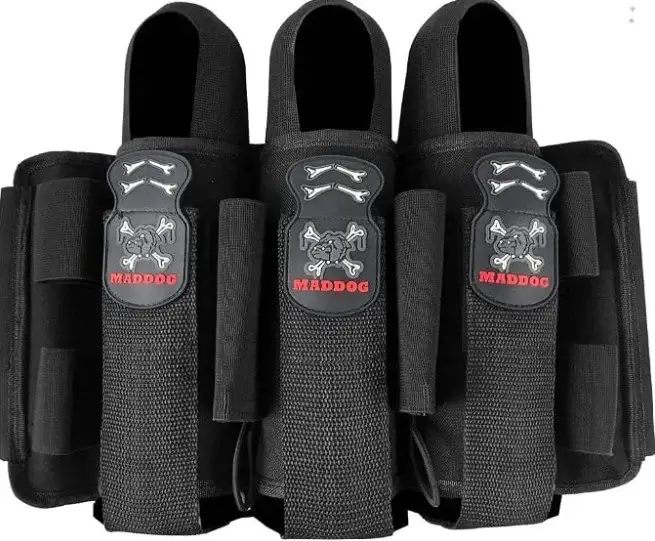
The Maddog Pro illustrates why capacity should match playing style rather than ego.
Maddog currently offers the harness in 3+2, 4+3, and 5+4 configurations with standard pod compatibility, adjustable support, elastic ejection, and retention straps.
A 3+2 setup emphasizes mobility. The 4+3 configuration provides a middle ground. The 5+4 version gives higher-volume players additional carrying potential.
Who it fits: Recreational players, beginners moving beyond hopper-only play, woodsball players, and anyone wanting adjustable capacity without jumping directly into a specialized tournament harness.
Who should skip it: Experienced competitive players specifically seeking a premium strapless system may want a different design.
Its useful feature is not merely the ability to carry more pods. It gives players multiple capacity choices while keeping the basic carrying concept familiar.
Paintball Gloves and Hand Protection
Paintball gloves should protect the hands without making the marker harder to operate.
Focus on:
- Palm grip
- Finger dexterity
- Knuckle protection
- Abrasion resistance
- Breathability
- Secure wrist fit
- Correct sizing
The trigger finger deserves particular attention. Heavy protection is not useful if the glove makes it difficult to operate the trigger, safety, loader, or other controls.
Gloves To Consider: KEMIMOTO Tactical Gloves
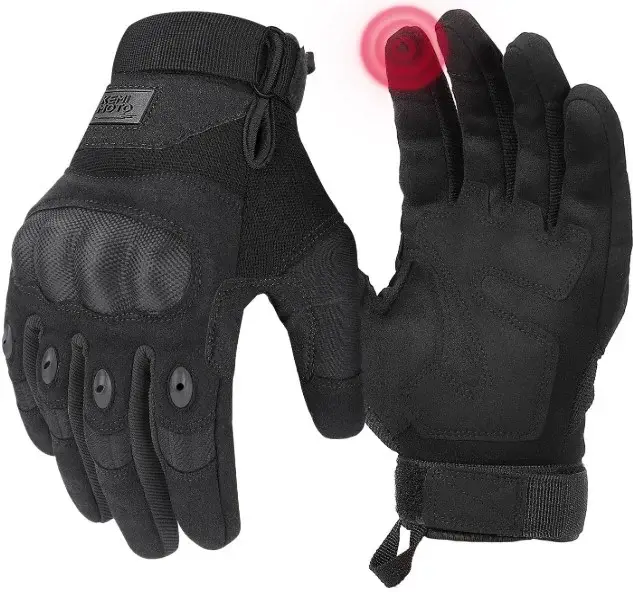
The supplied KEMIMOTO gloves are better viewed as a budget multi-purpose tactical option than a specialized professional paintball glove.
They use reinforced hand protection, palm padding, ventilation, and touchscreen-compatible fingertips.
That combination can appeal to recreational woodsball or scenario players who want more hand coverage than a thin sports glove.
The trade-off is bulk.
Hard protective areas and heavier construction may feel reassuring around branches and rough cover, but speedball players who prioritize maximum trigger feel may prefer slimmer paintball-specific gloves.
Who it fits: Recreational, woodsball, and scenario players who value hand protection and multi-purpose use.
Who should skip it: Players chasing the thinnest possible trigger feel or a dedicated competition glove.
The decision comes down to how much protection you want before hand mobility begins to suffer.
Knee Pads, Elbow Pads, and Body Protection
Extra protection becomes more valuable as movement gets more aggressive.
A player standing and walking through casual woodsball has different needs from someone repeatedly kneeling behind low bunkers or sliding into inflatable cover.
Knee Pads
Look for:
- Stable pad placement
- Flexible construction
- Coverage around the kneecap
- Ventilation
- A fit that does not cut circulation
Pads that slide below the knee during movement stop doing their job.
Elbow and Forearm Pads
These help when crawling, diving, and bracing against hard surfaces.
Again, mobility matters. Overly bulky protection can interfere with marker positioning.
Chest Protectors and Compression Padding
These can make sense for:
- New players worried about impact
- Younger players where field rules and sizing permit
- Close recreational environments
- Players who simply prefer added coverage
Padding should improve confidence and comfort without causing excessive heat buildup.
Slide Shorts
Speedball players who slide and dive repeatedly may appreciate padding around the hips and thighs.
For someone playing occasional standing woodsball, they may be unnecessary.
Paintball Pants, Jerseys, and Footwear
Regular athletic clothing can work for paintball, especially during the first few outings.
Purpose-built apparel becomes more useful when durability, range of motion, ventilation, and repeated contact with rough ground start exposing the limits of ordinary clothing.
Paintball Pants
Useful features include:
- Reinforced knees
- Stretch zones
- Adjustable waist
- Breathable panels
- Durable seams
- Useful pockets
- Freedom of movement
The best paintball pants are not necessarily the thickest. Heavy construction can become uncomfortable during hot games.
Paintball Jerseys
Look for:
- Lightweight fabric
- Ventilation
- Full shoulder movement
- Durable sleeves
- Enough space for chosen padding
A tournament jersey may prioritize mobility and airflow. Scenario clothing may emphasize abrasion resistance or camouflage.
Choose around the environment rather than appearance alone.
Paintball Footwear
Terrain should decide footwear.
- Soft cleats can work well on maintained grass or turf.
- Trail shoes can offer a useful blend of grip and mobility on mixed terrain.
- Hiking shoes or boots may suit uneven, muddy woodsball fields.
- Tactical boots can provide ankle support and durability but may feel heavier during fast movement.
There is no single best paintball footwear type for every field.
Cleaning Kits, Repair Supplies, and Useful Paintball Accessories
Small paintball supplies become valuable when they solve common field problems.
A basic maintenance setup can include:
- Barrel swab
- Squeegee
- Microfiber cloth
- Spare O-rings
- Correct lubricant
- Allen keys
- Spare batteries
- Basic replacement seals
- Cleaning kit
- Repair kit
Use the Correct Lubricant
Paintball markers do not all use the same lubricant.
Some require grease. Others use specific oils in specific locations. The wrong product can cause O-ring swelling, seal damage, or poor performance.
Follow the marker manual instead of assuming every bottle labeled “paintball oil” belongs everywhere.
Tank Covers
A tank cover can add grip and help protect the exterior finish. It may also change how the bottle sits against the shoulder.
Marker Stands
A marker stand is convenient at staging areas, especially for keeping equipment organized between games.
It is not an essential first purchase.
Marker Slings
Slings can be useful during scenario and woodsball games where a player carries equipment over longer periods.
They are much less relevant in typical speedball.
Remote Lines
Remote lines move the tank away from the marker, usually to the player’s back.
This can reduce marker-mounted weight but introduces hose routing and another component to manage.
Barrel Kits and Inserts
A barrel kit can provide bore options and equipment flexibility.
Do not assume that buying a large barrel kit will suddenly make inconsistent paint shoot perfectly. Paint quality, cleanliness, velocity consistency, and the marker itself continue to matter.
What Belongs in a Game-Day Repair Kit?
The goal is to solve ordinary problems, not perform a complete marker rebuild beside the field.
A useful game-day repair kit may include:
- Barrel swab
- Microfiber cloth
- Correct lubricant
- Spare O-rings recommended for the marker
- Basic Allen keys
- Spare loader and marker batteries
- Replacement detents if appropriate
- Small manufacturer-specific spare-parts kit
- Electrical tape or small utility tape for non-pressure-related emergency organization
- Clean storage bag for removed components
Do not casually disassemble regulators, tank valves, or other pressurized air-system components in the field.
Degas equipment according to manufacturer instructions before appropriate maintenance.
Sometimes the smartest repair is simply to stop, use a backup, and service the equipment properly later.
Paintball Gear Bags: Organize and Protect Your Equipment
An ordinary backpack works until the loadout starts multiplying.
Then you have a marker, tank, hopper, pods, harness, barrel pieces, clothes, batteries, tools, microfiber cloths, muddy shoes, and one mysterious broken paintball that somehow coats three unrelated objects.
A dedicated paintball gear bag becomes useful when organization starts saving real time.
Look for:
- Padded marker storage
- Barrel organization
- Tank space
- Accessory pockets
- Strong zippers
- Ventilation
- Water-resistant materials
- Backpack straps or wheels
- Expandable storage
- Separation between wet gear and clean equipment
Bag To Consider: HK Army Expand Gear Bag
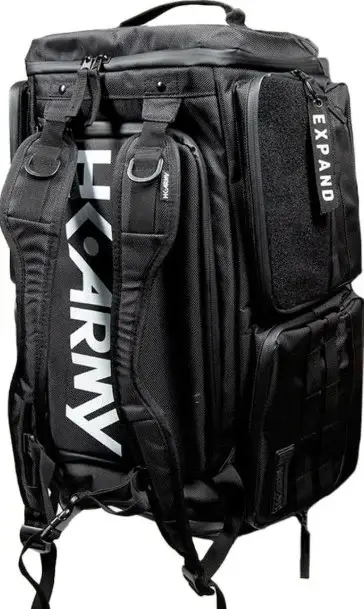
The HK Army Expand line suits players who have outgrown an ordinary day bag and now need paintball-specific storage.
HK Army’s current Expand gear-bag range includes paintball-focused models, and the Expand 75L uses a padded marker compartment, barrel loops, water-resistant exterior materials, MOLLE-equipped side pockets, heavy-duty zippers, and convertible carrying options.
That organization matters when a player is carrying multiple parts that should not spend the drive home bouncing together.
Who it fits: Regular players with a full marker setup, spare equipment, pods, apparel, and maintenance supplies.
Who should skip it: Someone carrying one rental-style setup a few times per year may still be perfectly served by a normal duffel.
The main trade-off is bulk. Dedicated gear bags encourage organization, but a large bag can also encourage bringing half the garage to a three-hour recreational session.
Paintball Gear for Beginners: What Should You Buy First?
The best paintball gear for beginners is usually much less exciting than the gear people want to buy first.
Reliability, safety, comfort, and compatibility deserve priority over upgrades.
Recommended Beginner Buying Order
- Proper personal protective equipment
- Reliable beginner-friendly marker
- Compatible air system
- Appropriate hopper or loader
- Pods and harness when extra paint becomes necessary
- Gloves and useful padding
- Better footwear or apparel when needed
- Gear bag once transportation becomes inconvenient
- Performance upgrades only after identifying a limitation
Renting during the first few outings can also be useful.
Rental equipment is rarely glamorous, but it teaches you what actually bothers you.
Maybe the first thing you notice is poor comfort. Maybe you dislike carrying a heavy marker. Maybe you barely shoot enough paint to need pods. Maybe you discover that woodsball interests you far more than speedball.
That experience is more useful than buying an entire paintball gear set based on product photos.
What Beginners Usually Do Not Need Immediately
Most new players can delay:
- Tournament-level electronic markers
- Premium carbon-fiber tanks
- Large barrel kits
- Oversized pod loads
- Extensive tactical gear
- Multiple backup markers
- Expensive apparel bought mainly for appearance
- Advanced tuning accessories
A beginner setup should be easy to understand and inexpensive to maintain before it becomes complicated.
Paintball Gear Kits and Packages: Complete Set or Separate Components?
A paintball gear kit can simplify the first purchase, but convenience does not guarantee that every included component is equally useful.
Paintball packages make the most sense for:
- First-time buyers
- Parents assembling a basic setup
- Recreational players
- Buyers who want basic component matching handled in advance
Before choosing a full paintball kit, check what the package actually contains.
What to Check in a Paintball Gear Bundle
Confirm:
- Exact marker model
- Tank type
- Tank capacity
- Whether the air source is refillable
- Hopper type
- Protective-equipment sizing
- Number and type of pods
- Replacement-parts availability
- Whether accessories solve real needs
- Whether individual components would provide better long-term value
A bundle stops being a bargain if two of its major components are immediately replaced.
Beginner Kit To Consider: Tippmann Cronus PowerPack Basic
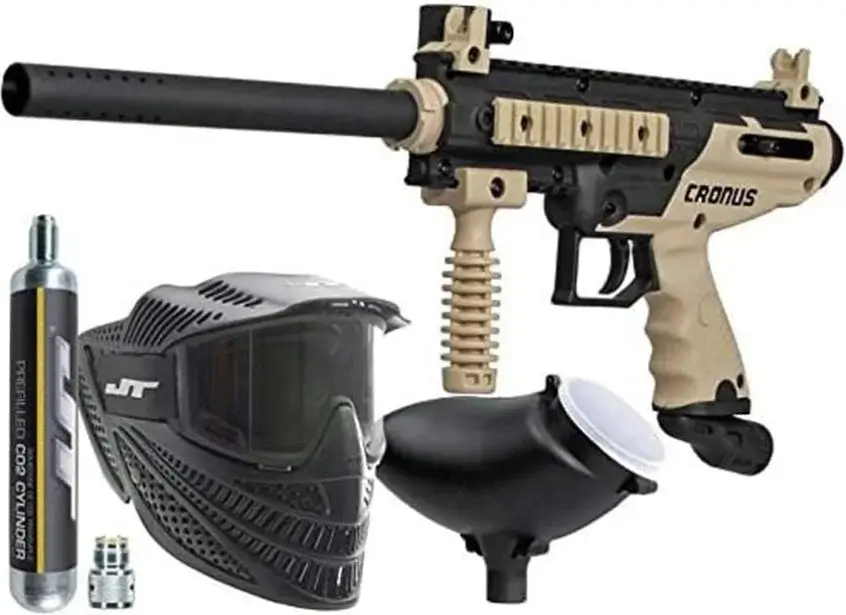
The Cronus PowerPack addresses one of the hardest parts of a first purchase: figuring out which basic pieces are required to make a marker usable.
The supplied package combines the Tippmann Cronus with a 90-gram CO2 source and adaptor, a 200-round gravity hopper, and a JT Raptor goggle.
Tippmann continues to feature the Cronus platform in its current lineup, and current Cronus package listings confirm that the marker can operate on CO2 or compressed air.
The marker itself uses Tippmann’s proven inline-bolt layout and uncomplicated recreational design.
Who it fits: A new recreational player who wants a straightforward first setup and values mechanical simplicity over advanced electronics.
Who should skip it: Someone already committed to competitive speedball will probably outgrow the basic gravity-fed and CO2-oriented package concept quickly.
There is also an important ownership consideration. The supplied 90-gram CO2 cartridge is a disposable starting air source rather than the kind of refillable HPA system many regular players eventually adopt. Current Cronus package information describes the 90-gram CO2 source as single-use.
That makes the package useful for simplifying the first purchase, not necessarily for defining the player’s permanent setup.
A regular player may eventually upgrade the air system, loader, carrying equipment, or other components as actual limitations become clear.
Paintball Gear by Playing Style
The same basic equipment changes character depending on how you play.
Recreational Paintball Gear
Prioritize:
- Reliability
- Simple maintenance
- Reasonable weight
- Affordable HPA where compatible
- Practical loader
- Comfortable footwear
- Modest paint capacity
Recreational players rarely benefit from building a tournament loadout before they know they need one.
Woodsball Gear
Woodsball introduces uneven ground, longer games, branches, mud, changing weather, and more time spent moving between areas.
Prioritize:
- Durable equipment
- Good traction
- Knee and elbow protection
- Weather-appropriate clothing
- Useful paint capacity
- Long-session comfort
- Straightforward maintenance
A few extra ounces may matter less than durability in this environment, but unnecessary tactical equipment can still become tiring.
Speedball Gear
Speedball rewards mobility and fast access.
Prioritize:
- Lightweight marker setup
- Balanced tank
- Reliable electronic feeding where appropriate
- Fast-access pod pack
- Knee and elbow protection
- Breathable apparel
- Good traction
- Easy field-side maintenance
A huge tactical vest provides little benefit when the priority is moving quickly between inflatable bunkers.
Tournament and Professional Paintball Gear
Competitive equipment should emphasize repeatable performance rather than collecting the most expensive components.
Prioritize:
- Consistency
- Low weight
- Reliable electronic loader
- Appropriate HPA capacity
- Stable pod pack
- Spare batteries
- Common replacement parts
- Organized tools
- Backup equipment at serious events
Tournament rules can change, including firing modes and equipment requirements. Do not build a competitive setup around an old forum post.
NXL currently publishes 2026 divisional rulebooks and supports multiple competition formats, so competitive players should consult the rulebook for the exact event and division they are entering.
Tactical and Magfed Paintball Gear
Tactical paintball gear makes sense when it improves carrying, access, or endurance.
It becomes dead weight when accessories are added only because empty MOLLE webbing looks lonely.
Common tactical gear includes:
- Tactical vest
- MOLLE platform
- Chest rig
- Battle belt
- Magazine pouches
- Utility pouch
- Dump pouch
- Marker sling
- Remote line
- Hydration pack
- Magfed magazines
- Camouflage clothing
Judge each item using five questions:
- What am I carrying with it?
- Can I reach that item quickly?
- Does it restrict movement?
- How much heat does it trap?
- Is the added weight solving a real problem?
A scenario player carrying magazines for a long game has a genuine reason for pouches.
A hopper-fed recreational player wearing eight empty magazine pouches mostly has more nylon.
Paintball Gear for Women: Fit the Player, Not the Label
Women’s paintball gear does not require an entirely different equipment ecosystem.
The more important differences usually involve fit, body proportions, marker reach, and comfort.
Pay attention to:
- Waist-to-hip fit
- Pant rise
- Jersey length
- Chest and torso room
- Knee-pad placement
- Elbow-pad sizing
- Harness adjustment
- Glove sizing
- Footwear fit
- Tank length
- Marker reach
- Overall balance
A harness can technically close around the waist while still fitting poorly during movement.
Likewise, a marker may be light enough on a scale but uncomfortable if a long tank pushes the shooting position too far forward.
Use actual body measurements whenever manufacturers provide size charts.
Do not assume that a generic small, medium, or large designation will translate cleanly across different brands.
Paintball Gear for Kids: Prioritize Weight, Fit, and Field Requirements
Paintball gear for kids needs to start with the individual field.
Age rules, equipment requirements, low-impact offerings, and supervision policies vary. Do not rely on one universal minimum age for every paintball facility.
Standard vs. Low-Impact Paintball
Some fields offer low-impact formats using smaller-caliber equipment.
That can significantly change:
- Marker type
- Paint size
- Loader setup
- Tank setup
- Rental options
Confirm the format before buying equipment.
Keep the Setup Manageable
For younger players, prioritize:
- Properly fitting protective equipment
- Lightweight marker setup
- Manageable air-system weight
- Smaller gloves
- Correct knee and elbow protection
- Proper footwear
- Harnesses that stay secure
- Sensible paint capacity
Oversized tactical equipment can make a young player’s first experience less comfortable rather than more exciting.
Renting first is especially useful for children because growth, interest level, strength, and field preference can change quickly.
New vs. Used Paintball Gear: What Is Worth Buying Secondhand?
Used paintball stuff can provide excellent value, but not every component carries the same risk.
Often Easier to Evaluate Used
- Gear bags
- Pods
- Harnesses
- Jerseys
- Pants
- Marker stands
Condition is relatively visible.
Inspect More Carefully
- Markers
- Electronic loaders
- Barrels
- Electronics
- Pads
- Regulators
- Air-related components
Check for:
- Leaks
- Missing hardware
- Battery corrosion
- Damaged wiring
- Stripped threads
- Worn detents
- Damaged O-rings
- Cracked loader shells
- Replacement-parts availability
- Signs of poor maintenance
A used electronic marker that “just needs an O-ring” may need an O-ring. It may also need an afternoon, three parts orders, and a sudden appreciation for mechanical markers.
Be Especially Careful With Used HPA Tanks
Inspect:
- Cylinder markings
- Manufacturing and test markings
- Physical damage
- Regulator condition
- Thread condition
- Applicable requalification status
- Authorized service-life limitations where applicable
U.S. regulations prohibit filling certain cylinders once periodic requalification requirements are overdue and require appropriate visual inspection and qualification procedures.
Do not buy a used tank simply because the seller demonstrates that it still contains pressure.
Holding pressure is not the same thing as being legally or safely eligible for continued filling.
When Is Paintball Gear Actually Worth Upgrading?
New paintball gear is worthwhile when it removes a limitation you can identify.
Upgrade when:
- Your loader cannot feed reliably enough
- Your tank makes the marker unnecessarily tiring
- Your pod pack shifts during movement
- Your pads will not stay positioned
- Your footwear lacks traction
- Your gear bag no longer protects the setup
- Your marker has become unreliable
- Replacement parts are difficult to obtain
- Your current equipment no longer suits your playing format
Do not upgrade simply because a newer model has a larger specification.
Upgrade the Problem, Not the Product Category
If the marker shoots consistently but the hopper starves during fast strings, look at the loader.
If the marker feels heavy after several games, inspect the tank and overall balance before replacing the marker.
If accuracy suddenly becomes poor, check:
- Paint quality
- Barrel cleanliness
- Velocity consistency
- Paint breakage
Before buying a barrel kit.
The most useful upgrade is usually the one that removes the problem you can already feel.
Build the Best Paintball Gear Setup for How You Actually Play
There is no universal best paintball gear loadout.
There are only setups that make more or less sense for a particular player.
First-time player: Start with proper protection, a reliable marker, compatible air, a suitable hopper, and comfortable footwear.
Regular recreational player: Add dependable HPA, practical paint carrying, gloves, useful padding, maintenance supplies, and better organization.
Woodsball player: Prioritize durability, traction, long-session comfort, protection, and enough carrying capacity for the game format.
Speedball player: Reduce unnecessary weight and focus on balance, reliable feeding, fast pod access, mobility, and protection for repeated slides and dives.
Tactical or magfed player: Build the carrying system around magazines, air, hydration, and other equipment you genuinely need. Avoid adding weight purely for appearance.
Tournament player: Focus on consistency, lightweight equipment, fast access, current rule compliance, replacement parts, batteries, and dependable backups.
The best paintball gear is not the setup with the longest shopping list. It is the one where the marker, air system, loader, paint-carrying equipment, protection, apparel, accessories, and maintenance supplies work together without making the game harder.
Buy the essentials first. Play enough to discover the weak points. Then upgrade the problem that actually appears.
That approach usually produces a better loadout than chasing every new paintball accessory that looks useful from a product page.